
Forever Number 20: The Life and Death of Diogo Jota
From Gondomar to Anfield, the story of the number that will never be worn again
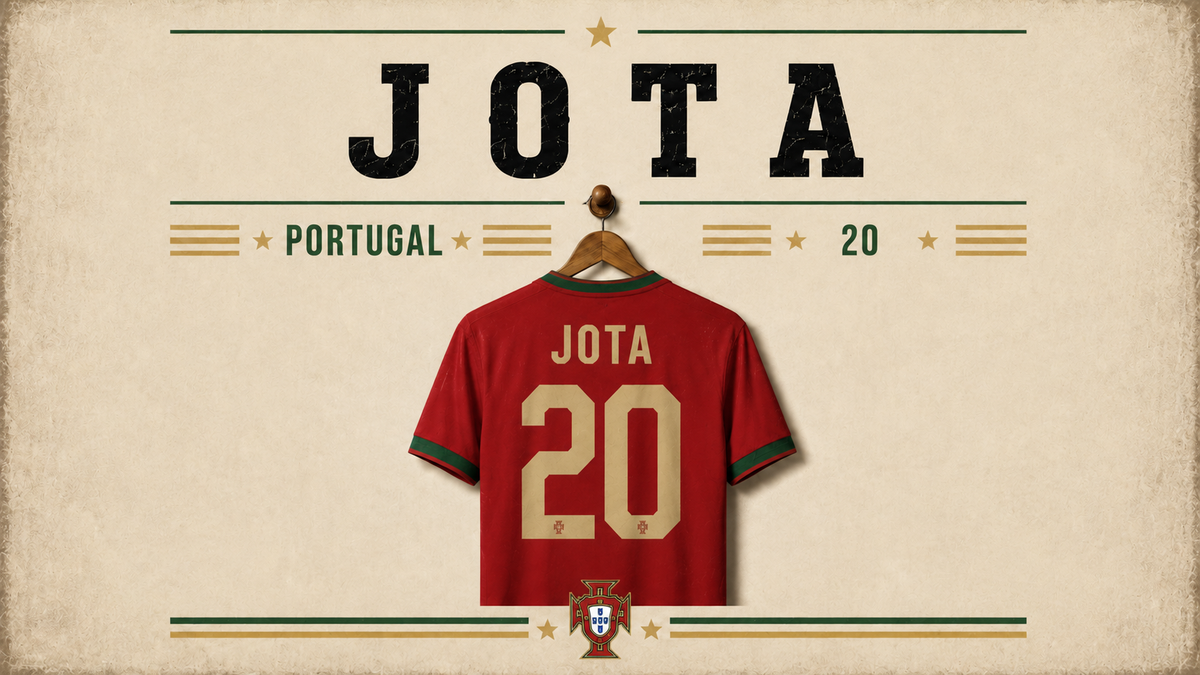
From Gondomar to Anfield, the story of the number that will never be worn again
The final whistle went in Toronto and Cristiano Ronaldo, forty one years old and now the oldest man ever to score in a World Cup knockout game, reached for a shirt that was not his own. Number 21. He pulled it over his head, gathered his teammates into a circle and pointed at the sky. The stadium had just watched him drag Portugal level from the penalty spot against Croatia. Now it watched him cry.
The morning after would mark a year to the day since Diogo Jota died on a Spanish motorway with his younger brother beside him. Portugal had spent that year learning to carry him. On Thursday night, in a World Cup he never got to play, they carried him into the last sixteen.
This is the story of the man in that shirt. It begins with a boy who was too small.
Diogo José Teixeira da Silva was born in Porto on 4 December 1996 and raised in Gondomar, a working town on the eastern edge of the city where the Douro bends towards the sea. He joined the local club, Gondomar Sport Clube, at nine and stayed until he was seventeen, which in Portuguese football is roughly the length of time it takes for every big academy in the country to look at a small forward and decide he will not grow into the job. They all looked. They all passed. The frame was slight, the scouts were unmoved and the boy kept scoring anyway.
The name came early too. There were other Diogos in those Gondomar dressing rooms, so he took the initial of José, his second name, and wore it as the Portuguese letter itself. Jota. The letter J, spoken aloud. It is the kind of detail that reads like invention and is merely true, a footballer named after a single letter, as if the game already suspected the rest of the alphabet would not be needed.
Gondomar never forgot the boy the giants turned down. In 2022, with Jota by then a Premier League forward and a Champions League regular, the club renamed its academy after him, so that every small kid who walked through those doors would train under the name of the smallest kid who ever did. There is a version of this story where that is the sentimental flourish at the end. It sits instead in the middle, because the end had other plans.
Rejected by the big academies, he signed for Paços de Ferreira in 2013, a modest top flight club in a furniture town east of Porto, and made his senior debut on 19 October 2014, starting in a 4-0 win a few weeks before his eighteenth birthday. Two seasons was all Paços could hold him for. In 2016 Atlético Madrid came, which sounds like the fairy tale arriving on schedule and was in fact the fairy tale taking a wrong turn. Jota signed for Atlético and never played a competitive match for them. Diego Simeone's squad was a fortress with no spare rooms. He was loaned back to Porto for a season, the club of his own city, and scored freely without ever convincing them to keep him.
Then he made the decision that built the rest of his life. In the summer of 2017, aged twenty, with a La Liga contract in his drawer, he dropped into the English second tier to join Wolverhampton Wanderers. Players going the other way, from the Championship to Madrid, are called ambitious. Players going Jota's way are called finished. He was neither, and he knew it, and the year that followed was one of the great vindications of a footballer betting on his own judgement.
The Wolves he joined were not a normal second tier club. Nuno Espírito Santo had arrived that same summer with a squad being rebuilt along Portuguese lines, and Jota walked into a side that intended to pass its way out of the division rather than fight its way out. They did. Wolves won the Championship at a canter, Jota lit up the promotion season and the move was made permanent in 2018. Over three years in the Midlands he scored forty four times and turned himself from a curiosity into a Premier League forward that the biggest clubs now had to explain why they were not signing.
Liverpool stopped explaining in September 2020. Jürgen Klopp brought him to Anfield to disturb a settled front three of Salah, Mané and Firmino, which was a little like being hired to improve the weather. Jota disturbed it within weeks. He scored on his league debut, he scored in the Champions League, he scored the sort of goals that do not photograph well, close range, improvised, taken half a second before anyone else on the pitch had registered the chance. Klopp called him a pressing machine. Anfield called him something better. The Kop gave him a song built on a simple boast, that he was better than Figo, and sang it with the total sincerity that only a terrace joke can hold.
The numbers, for the record keepers, would eventually read sixty five goals in one hundred and eighty two appearances across five seasons. But Jota was never really a player you counted. He was a player you noticed, or rather a player you failed to notice until the ball was already in the net, arriving late and low at the near post while the defence was still marking the shape of the attack as it had existed a heartbeat earlier. Klopp used to marvel at it. Teammates spoke about it with the particular respect professionals reserve for a skill they cannot explain. He scored goals nobody saw coming, and he did it for five years.
He wore the number 20. Remember the number.
There was another side to him that endeared him to a generation his elders barely understood. Jota was a gamer, seriously so, and in February 2021 he was ranked the world number one on the FIFA 21 Champions Leaderboard, an actual global ranking, while simultaneously playing for the actual Liverpool. During the lockdown of 2020 he won the Premier League's invitational FIFA tournament, beating Trent Alexander-Arnold in the final, a Liverpool player defeating a future teammate at a simulation of the sport that employed them both. He ran his own esports team. He streamed. He was, in the fullest modern sense, a footballer of his time, and the game loved him back in both of its forms.
On the grass, the medals arrived. The FA Cup and the League Cup in 2022, Wembley twice in a single season, Chelsea beaten twice, penalties twice. Jota was central to both runs in a campaign when Liverpool chased all four trophies to the final week. Another League Cup followed in 2024. And then the one that mattered above all the others. In the spring of 2025 Liverpool won the Premier League, the twentieth league title in the club's history, and the number 20 shirt was worn all season by Diogo Jota. His contribution had been trimmed by injury, six league goals, but one of them was the last he ever scored, a winner against Everton in the April of the title run, a Merseyside derby settled by the little forward from Gondomar in front of the Kop. Nobody knew it was a farewell. The best farewells never announce themselves.
His country ran on a parallel track. Jota made his Portugal debut on 14 November 2019 against Lithuania in the Algarve, sharing a forward line with Cristiano Ronaldo, the man who would one day wear his shirt.
He scored at Euro 2020, a consolation in a wild 4-2 defeat to Germany, and played every game of that campaign until Belgium ended it in the last sixteen. He struck twice in the 9-0 demolition of Luxembourg that stands as Portugal's biggest ever win. He went to Euro 2024 and played three times before France put Portugal out on penalties in the quarter finals, another tournament that ended a round or two before the story demanded. In forty nine appearances for the national team he scored fourteen goals, and on 8 June 2025 he stood in Munich as Portugal drew 2-2 with Spain and then beat them in the shootout to win the Nations League. There is a photograph from that night of Jota posing with the trophy, grinning, weeks from his wedding, the summer opening up in front of him. It was the last act of his international life. He never knew it either.
The wound in the middle of that international story is Qatar. In October 2022, a month before the World Cup he had called one of his dreams, Jota played the full ninety minutes of a 1-0 win over Manchester City. Four days earlier he had laid on three assists for a Salah hat trick against Rangers. He was flying. Against City he pressed and chased to the very end, and in the final minute the calf went, badly, and he left Anfield on a stretcher. The scan ruled him out for months. The World Cup went on without him. Every player who misses a tournament through injury tells himself there will be another one. For Jota, 2026 was the other one.
Two thousand and twenty five was to be the summer of his life. On 22 June, eleven days before the end, he married Rute Cardoso in Porto. They had been together since school, childhood sweethearts in the least ironic sense available, and they had three children, the youngest barely a year old. He posted the photographs with a caption of four words. Yes to forever. It is unbearable to read now and it was perfect then, a man at twenty eight with the league title won, the Nations League won, the wedding done, the whole second act of a life laid out in front of him.
Eleven days.
Jota had undergone a minor lung procedure that summer and doctors advised him not to fly. So he chose the road. He and his brother André Silva, a twenty five year old professional with Penafiel in the Portuguese second division, set off by car through Spain, heading for Santander and the ferry to England, where Liverpool's training was due to resume within days.
Just after midnight on 3 July 2025, on an isolated stretch of the A52 near Cernadilla in the province of Zamora, their Lamborghini left the road and caught fire, the flames spreading into the vegetation at the roadside until the firefighters arrived. No other vehicle was involved. The Guardia Civil's early account spoke of a tyre failing during an overtake. A suggestion of excess speed was later disputed by lorry drivers who had seen the car pass calmly minutes before, on a road they described as dark, dangerous and badly kept. The investigation ground on and the question of who was driving was never publicly settled. None of it changed the only fact that mattered. Both brothers died at the scene, an hour or so from the border of the country that adored them.
The mourning was immediate and it was everywhere. At Anfield the flowers began arriving within hours, scarves and shirts and handwritten notes spreading along the railings until the stadium seemed to stand behind a tide of red. A banner appeared carrying the club's anthem, its promise suddenly literal. Moments of silence were held at the Women's European Championship that same evening, where Portugal happened to be playing Spain, of all teams, in Switzerland. Wimbledon told its players they could wear black ribbons. FIFA grieved, UEFA grieved, the Prince of Wales wrote of his sadness as part of the footballing family. It is rare for the sport to speak with one voice. For a few days in July it managed it.
The bodies came home to Gondomar. The wake filled the town, the Prime Minister and the President among the mourners, and on the Saturday morning the funeral mass was held at the parish church, Rúben Neves, his oldest friend in football, carrying the coffin, Virgil van Dijk and Andy Robertson carrying flowers shaped as the shirts of the two brothers. They were buried side by side in the cemetery next to the church, a few minutes from the pitches where a small boy had once been told he was too small.
The tributes did what tributes do, and then some of them did more. Klopp, the manager who signed him, wrote that he was struggling, that there must be a bigger purpose and that he could not see it. Arne Slot, the manager who had just won the league with him, said simply that they had shared a dream and fulfilled it together. Ronaldo, stunned, wrote that it made no sense, that they had only just been together with the national team, that Jota had only just married. And on the Friday night after the funeral, at twenty past eight, Liverpool announced that the number 20 would never be worn again, by anyone, at any level of the club, the first shirt retired in the club's entire history. Michael Edwards, the executive who had sanctioned his signing, put it in a single line. He will be forever our number 20. The man who joined in 2020, wore 20 and won the club its twentieth title.
Liverpool's first match without him was a friendly at Preston that felt nothing like a friendly. You'll Never Walk Alone before kick off, a wreath laid by the home club in front of the travelling support, a minute's silence, black armbands, his face on the screens. Pre season fixtures are usually the most disposable dates in football's calendar. This one will be remembered by everyone who stood through it.
Portugal made their own arrangements with memory. Rúben Neves, who had shared a dressing room with him at Wolves and for years with the national team, and who had carried his coffin through Gondomar, took the number 21 for Portugal and has worn it since, a friend keeping a seat occupied. And when the World Cup arrived in the summer of 2026, the tournament Jota had waited his whole career for, the squad carried him with them across the Atlantic, wristbands and remembrance folded into the campaign from the first day.
Which brings the story back to Toronto, and to Thursday night.
Portugal against Croatia, the round of 32, a place in the last sixteen against Spain waiting in Dallas. Before kick off the stadium screens showed his face. During the anthem several Portuguese players wept openly. Then Croatia scored, and Portugal, as they have made a habit of doing, refused the script. Ronaldo levelled from the spot, his first goal in a World Cup knockout match in a career that has contained almost everything else, and at forty one the oldest scorer the knockout rounds have ever seen. Deep in stoppage time Gonçalo Ramos headed the winner. Croatia thought they had equalised at the death and the flag ruled it out. Luka Modric's international story ended on the other side of the same night. Football rarely writes with restraint.
Two dates hold this story like bookends. On 14 November 2019, in the Algarve, a small forward from Gondomar made his Portugal debut alongside Cristiano Ronaldo, the greatest player his country has produced, a boy stepping into the frame beside the legend. On 2 July 2026, in Toronto, the legend stepped into the boy's shirt. Everything Diogo Jota was runs through the gap between those two nights, six and a half years in which he went from the newest name on the team sheet to a name the team cannot stop saying.
And at the whistle, Ronaldo asked for the shirt. Not his 7. The 21. He put it on, stood among his teammates and pointed upwards, and afterwards he spoke about the coincidence of the date in the halting way men speak when the coincidence is too large for language. Ramos said they talk about Jota every day. Rafael Leão said he is always with them, that he had helped them win. In the morning it was 3 July again, one year exactly, and Portugal were still in the World Cup, still carrying the forward who never got to play in one.
There is no consolation in any of this and it would be an insult to manufacture one. A wife lost her husband of eleven days.
What football can do is what it did in Toronto. It can keep a man present. Diogo Jota was the boy who was too small, the letter that became a name, the forward who dropped down a division to climb higher than any of the clubs that rejected him. He won the cups, he won the league, he won for his country, he married the girl from school and he said yes to forever. He was twenty eight. At Anfield his number will never be worn again, and in the white heat of a World Cup his captain wore it for him, one year on, in front of the watching world.
On Monday Portugal play Spain in Dallas, the team they beat in Munich on the last great night of his life, for a place in the quarter finals of the tournament he dreamed about. Whatever happens there, the shirt has already done its work. Grief looks for somewhere to stand, and on Thursday night it stood in the middle of a football pitch in Canada, wearing the number 21, pointing at the sky.
Forever their number 20. Forever, for one night in Toronto, the 21 on Ronaldo's back.