Pelé Was Great. Messi Is Perfect. Maradona Was a God
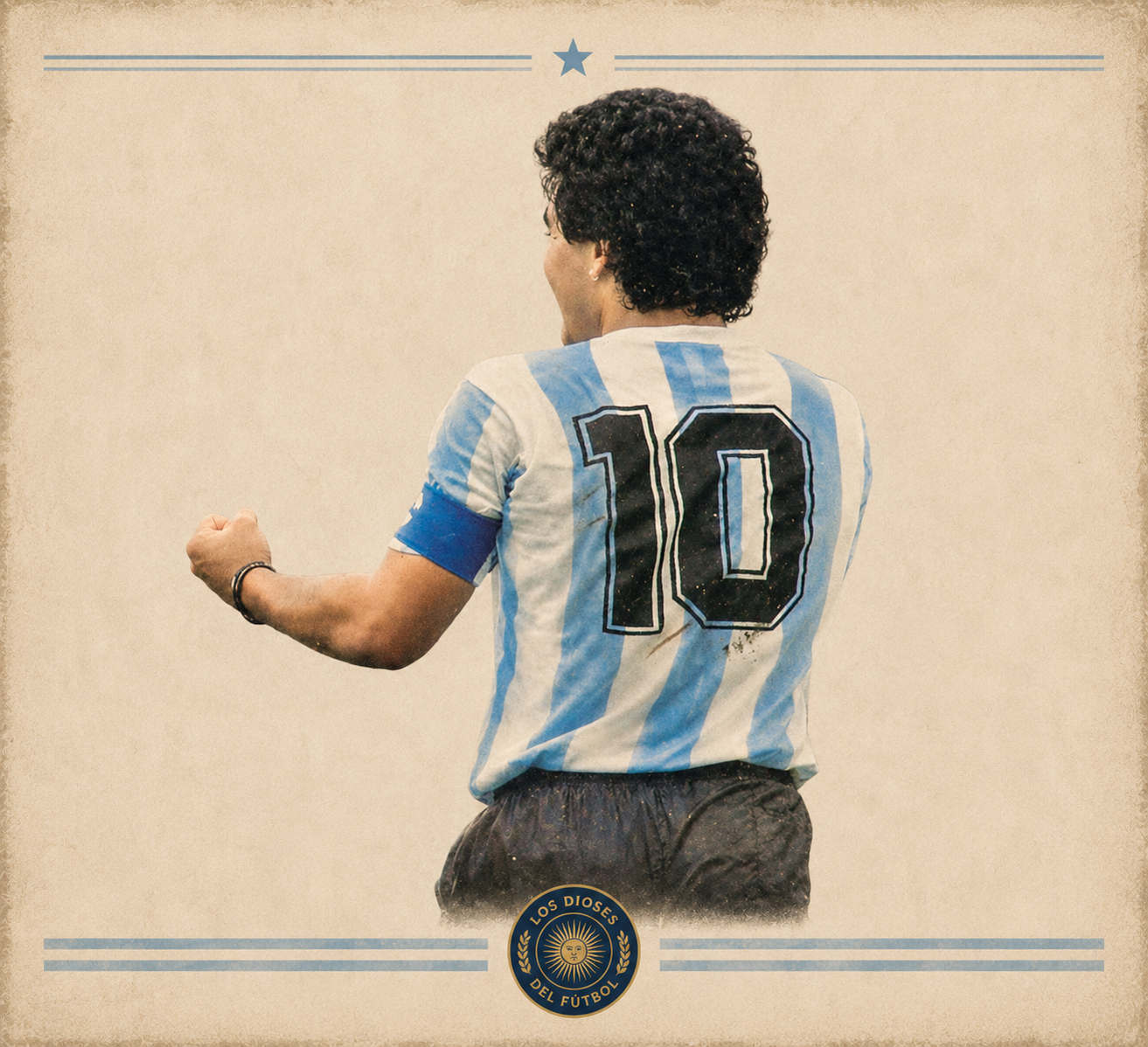
A God Born in Lanús and Made in Naples
Every other footballer gets a biography. This legend of the game gets a church. A real one, with commandments and a calendar and a congregation that counts the years from his birth the way the rest of us count from a different baby in a different manger. That is the thing you have to hold in your head before you can make any sense of Diego Armando Maradona. He is not measured against other players. He is measured against deities. And the strange part, the part that should be impossible, is that the comparison holds up.
This is the story of how a boy from a shantytown with no running water ended up worshipped as a literal god by hundreds of thousands of people across more than a hundred countries. It is not a tidy story. Gods rarely are.
Genesis: Villa Fiorito
He was born on 30 October 1960 in Villa Fiorito, a shantytown on the southern edge of Buenos Aires where the roads were dirt and the houses were tin and the future was not something anybody bothered to plan for. There was no running water. There was, however, a football, and that turned out to be enough.
The legend started early because the talent did. He was given his first ball at the age of three and by all accounts barely let go of it again. The local club Argentinos Juniors had a youth side called Los Cebollitas, the Little Onions, and the young Maradona did not so much join them as carry them. At half time during first team matches he would come out and juggle the ball for the crowd, and the crowd would stay in their seats rather than queue for a drink, because the show was the child. People came to watch a boy keep a ball off the ground. That should tell you everything.
He made his professional debut for Argentinos Juniors on 20 October 1976, ten days short of his sixteenth birthday. A boy in a man's league, and the league simply could not cope. The ball seemed magnetised to his left foot. He was short and squat and low to the ground, built like nothing a coaching manual would draw up, and that low centre of gravity meant defenders who lunged at him found only the space where he had just been. By eighteen he was the best player in Argentina. By twenty he had moved to Boca Juniors and won a league title and the country had already decided he belonged to them.
The wider world got its first proper look in 1979, when he dragged Argentina to the World Youth Championship in Japan and was named the player of the tournament. The script was being written in real time, and everybody could read it. Here was the saviour. The only question left was how high he could climb, and whether anyone or anything could stop him on the way up.
Plenty would try. None of it worked for long.
The Case for a Football God
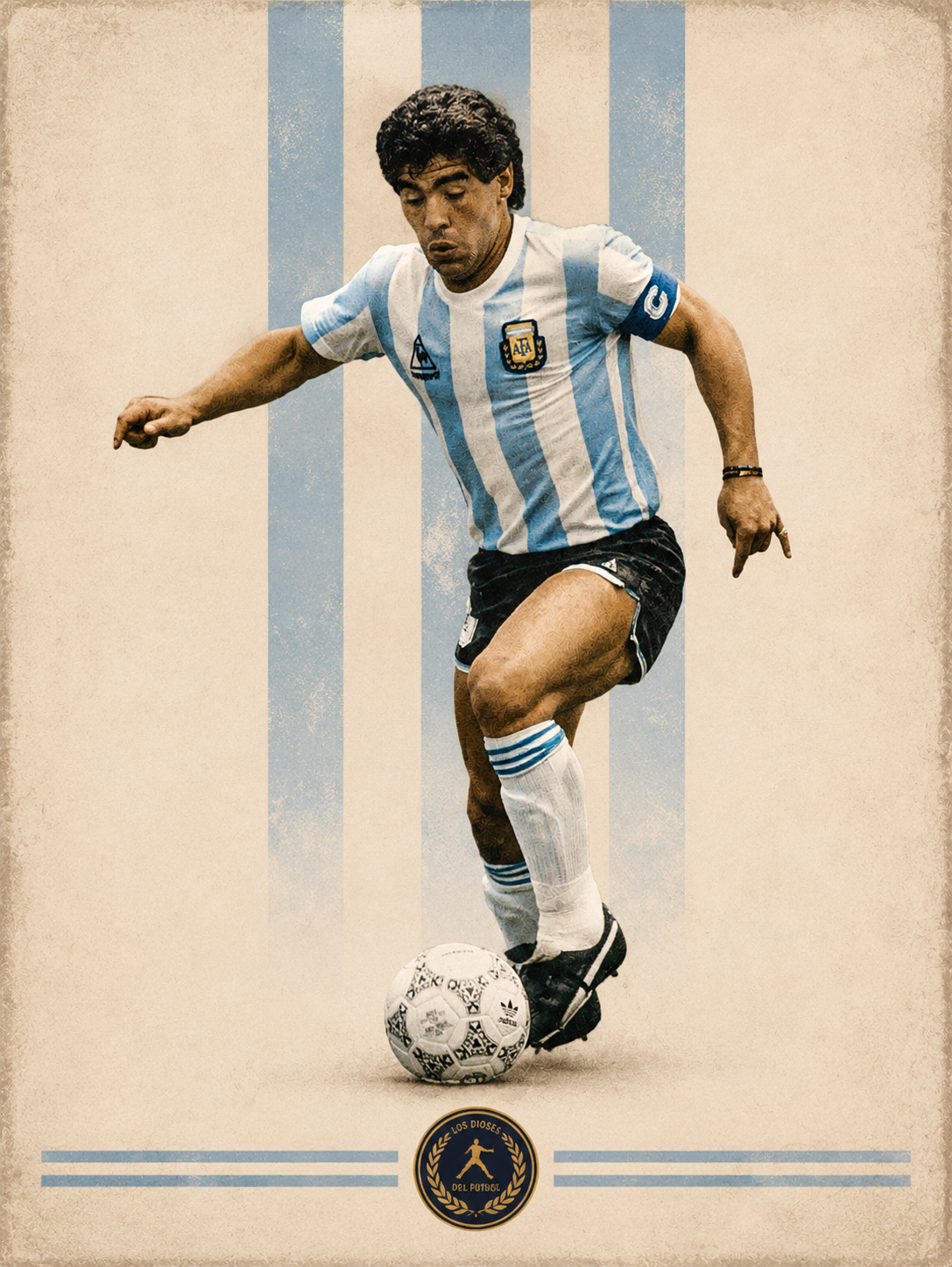
You cannot talk about Maradona for long before somebody says the name Pelé, and somebody else says Messi, and the whole thing collapses into the oldest pub argument in the sport. Who was the greatest. It is a fine argument and it misses the point entirely, because greatness is not what makes Maradona different. Lots of players have been great. Only one has been worshipped.
Think about what the other candidates offer. Pelé gives you perfection, three World Cups and a thousand goals and a lifetime of corporate dignity, the game's first global ambassador in a blazer. Messi gives you serenity, a quiet genius who made the impossible look like a routine he had rehearsed, a man whose worst sin was being too good to be interesting. Both are magnificent. Neither is a god, because gods are not magnificent. Gods are contradictory. They create and they destroy, they bless and they punish, and the people who follow them do so not in spite of the chaos but because of it.
That is the whole case for Maradona's divinity, and it rests on a single afternoon we will come to in a moment. In the space of four minutes he committed the most outrageous cheat the World Cup has ever seen and then scored the most beautiful goal the World Cup has ever seen, against the same opponent, with the same ball, using the same body. The sinner and the saviour were one man. You did not have to choose between them because he refused to let you. He gave you the fraud and the miracle as a matching pair and dared you to keep only the half you liked.
No god worth the name is uncomplicated. The Greek ones cheated and seduced and threw thunderbolts in fits of temper. The point of a god is not that he is good. The point is that he is more than human, that he operates above the rules the rest of us are bound by, and that he can be terrible and glorious in the same breath without any apparent contradiction. Maradona spent his whole life proving he qualified.
So set the greatest debate aside. It is the wrong question asked of the wrong man. Pelé and Messi are the finest footballers who ever lived. Maradona is something stranger and rarer and, to the people who love him, something larger. He is the one they built an altar for.
The Miracles: Four Minutes at the Azteca
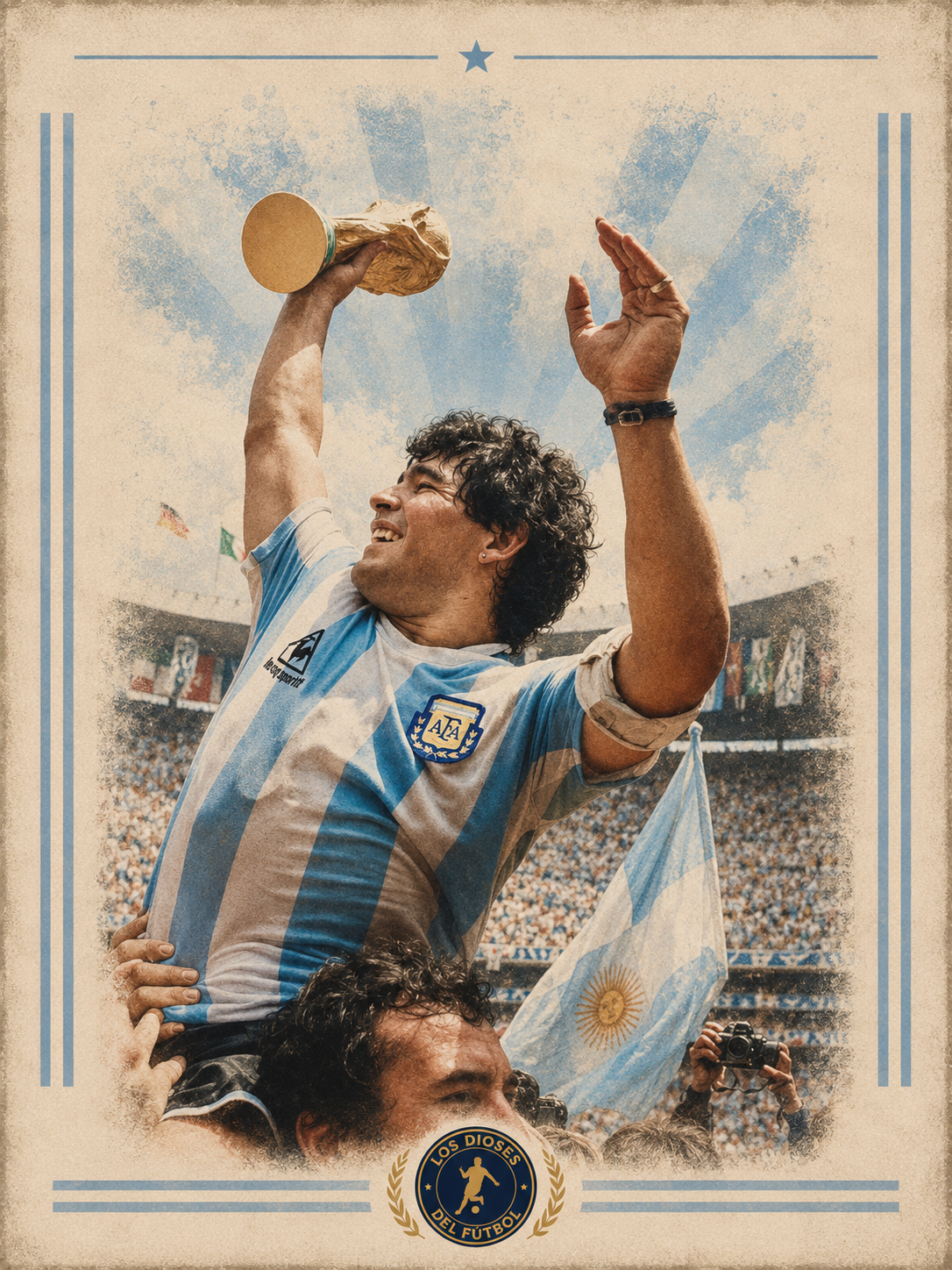
22 June 1986. The Estadio Azteca in Mexico City. A hundred and fourteen thousand people watched a quarter-final between Argentina and England. It was a game that nobody on either side had managed to keep entirely about football. Four years earlier the two countries had fought a war over the Falklands. Hundreds of young men had died. You did not need to mention any of that out loud for everyone in the stadium to feel it humming under the surface. This was never just a match.
For an hour the game was tense and tight and goalless, the kind of game that turns on a single moment. It turned on two, and they arrived inside four minutes of each other, and between them they contained the entire contradiction of the man.
The first came in the 51st minute. Maradona played the toward Jorge Valdano on the England box and kept running. When a hurried Steve Hodge clearance looped up into the air he rose with the goalkeeper Peter Shilton to meet it. Shilton was six feet tall. Maradona was five foot five.
There was only one way the small man was winning that header and it did not involve his head. Maradona reached up with his left fist, punched the ball over Shilton and into the net, and wheeled away celebrating before anyone had worked out what they had seen.
The referee had not seen it.
The linesman had not seen it.
The goal stood. The whole of England stood still, while the whole of Argentina cheered. Asked afterwards how he had scored it, Maradona produced one of sport's immortal lines, that it was scored a little with the head of Maradona and a little with the hand of God.
La mano de Dios.
He later admitted it was his hand and called it symbolic revenge for the Falklands, which was honest and unrepentant and entirely in character.
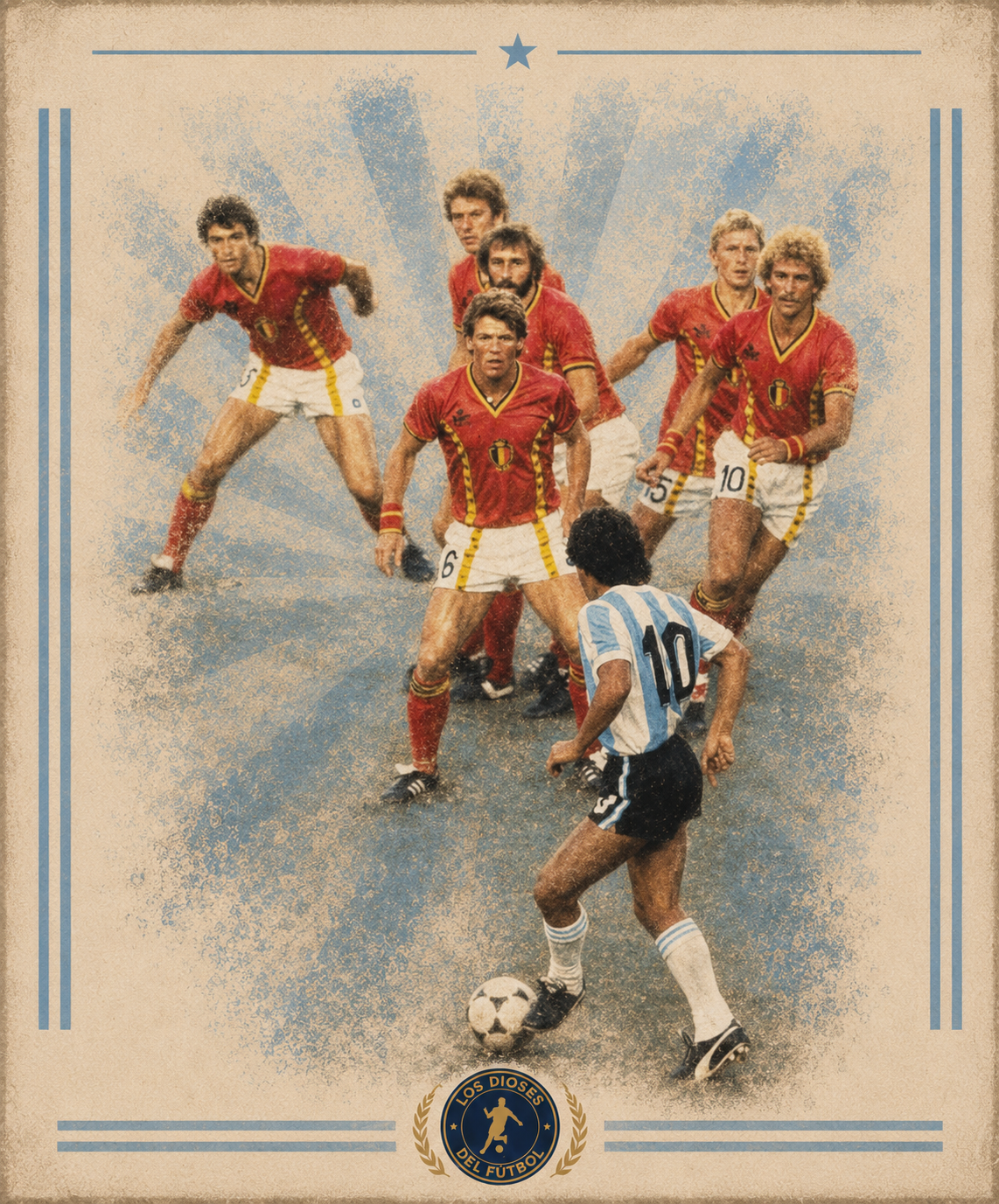
Four minutes later Maradona scored the other goal. The one that needs no defending. He collected the ball inside his own half, turned, and set off, and what followed was less a run than a sentence the rest of the pitch could not finish. He beat one man, then another, then carried the ball sixty yards through the middle of an England team that simply could not lay a boot on him. Maradona went past five white shirts with ease. He then dummied Shilton, before rolling the ball into the empty net. In 2002 FIFA held a vote and it was named the Goal of the Century. There has been no serious challenger since.
So there it is, the theological heart of the whole story, the reason this man and no other gets a church. The cheat and the masterpiece, the hand of God and the feet of one. Goals separated by two hundred and forty seconds and joined forever in the memory. Argentina won 2-1.
They went on to win the tournament, with Maradona taking the Golden Ball as the best player at it, having more or less dragged an ordinary team to the title by the collar. People still call it Maradona's World Cup, because it was nobody else's.
England have never quite forgiven him. Naples never had to.
The Patron Saint of Naples
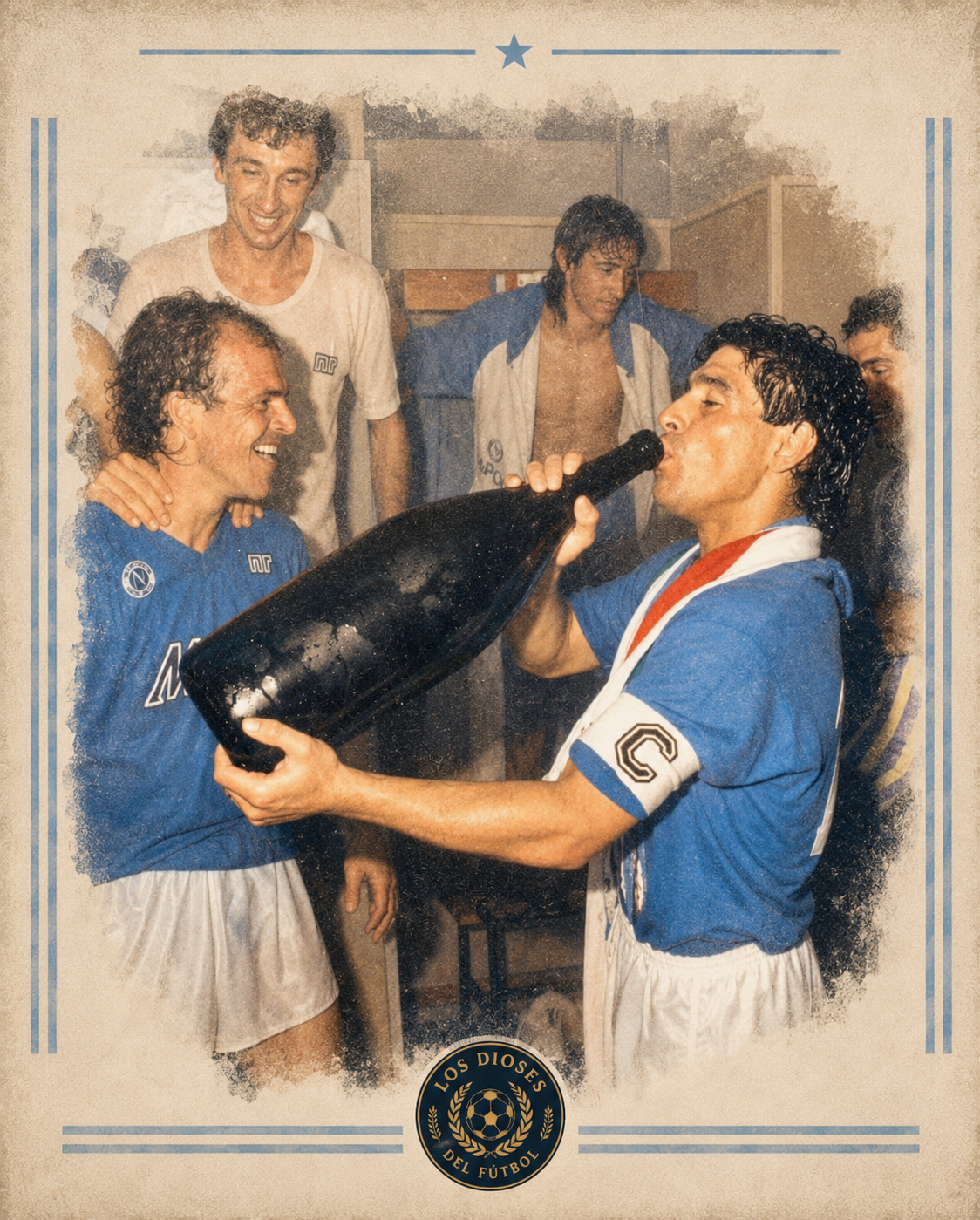
To understand what happened next you have to understand Naples, and to understand Naples you have to understand that Italy has always treated its south as an embarrassing relative.
The money lived in the north, in Milan and Turin, and so did the trophies. Juventus and the Milan clubs won everything and the south won nothing and was reminded of it, loudly, every week. Napoli had existed since 1926 and never won a league title. They were a joke with a beautiful view.
In 1984 Maradona signed for them from Barcelona for a world record fee. He could have gone anywhere. Jorge Cyterszpiler, Maradona's first agent, is the man who ran his career and his money from the teenage years through Barcelona and into Napoli. Then the finances collapsed and Cóppola replaced him around 1985.
The Camorra wanted the deal. The patron saint of Naples, was delivered to the door by his accountant and the mob.
He went to the poorest, most mocked, most desperate big club in Italy, the one with everything to prove and nothing to lose, and something in that wager spoke to him. After the deal was agreed upon, Barcelona's president attempted to delay the move by demanding an extra £500,000. To push the transfer over the line, the desperate people of Naples literally began collecting funds in the streets to help the club pay the difference. Seventy thousand people turned up at the stadium just to watch him be presented. He had kicked nothing yet. It did not matter. Hope had arrived in a number ten shirt and the city lost its mind.
What he did over the next seven years is, in pure footballing terms, the most remarkable thing he ever achieved, more remarkable even than 1986, because in 1986 he had a national team around him and at Napoli he had considerably less. He took a club that had won nothing in nearly sixty years and won them their first Serie A title in 1987, the year after the World Cup, completing a domestic double with the Coppa Italia for good measure.
He won them a UEFA Cup in 1989, the only major European trophy in the club's history before or since. He won them a second league title in 1990. He turned the joke of Italian football into its champion, and he did it in the teeth of a north that loathed him for it.
The city responded the only way a Catholic south knows how. It made him a saint. Murals of his face went up on the sides of buildings and stayed there. A shrine appeared containing what was claimed to be a strand of his hair, kept and venerated like a holy relic. Naples already had a patron saint, San Gennaro, whose dried blood is said to liquefy on cue twice a year as a sign of the city's good fortune. Maradona slotted in alongside him without anyone needing it explained. One saint for the soul and one for the football, and not everyone in Naples was sure which mattered more.
He gave them their pride back. That is what they could never repay, and never forgot. The trophies were almost beside the point. He had made the south feel worthy, for the first time in living memory, and a city does not forget the person who does that. It builds him an altar instead.
The Fall
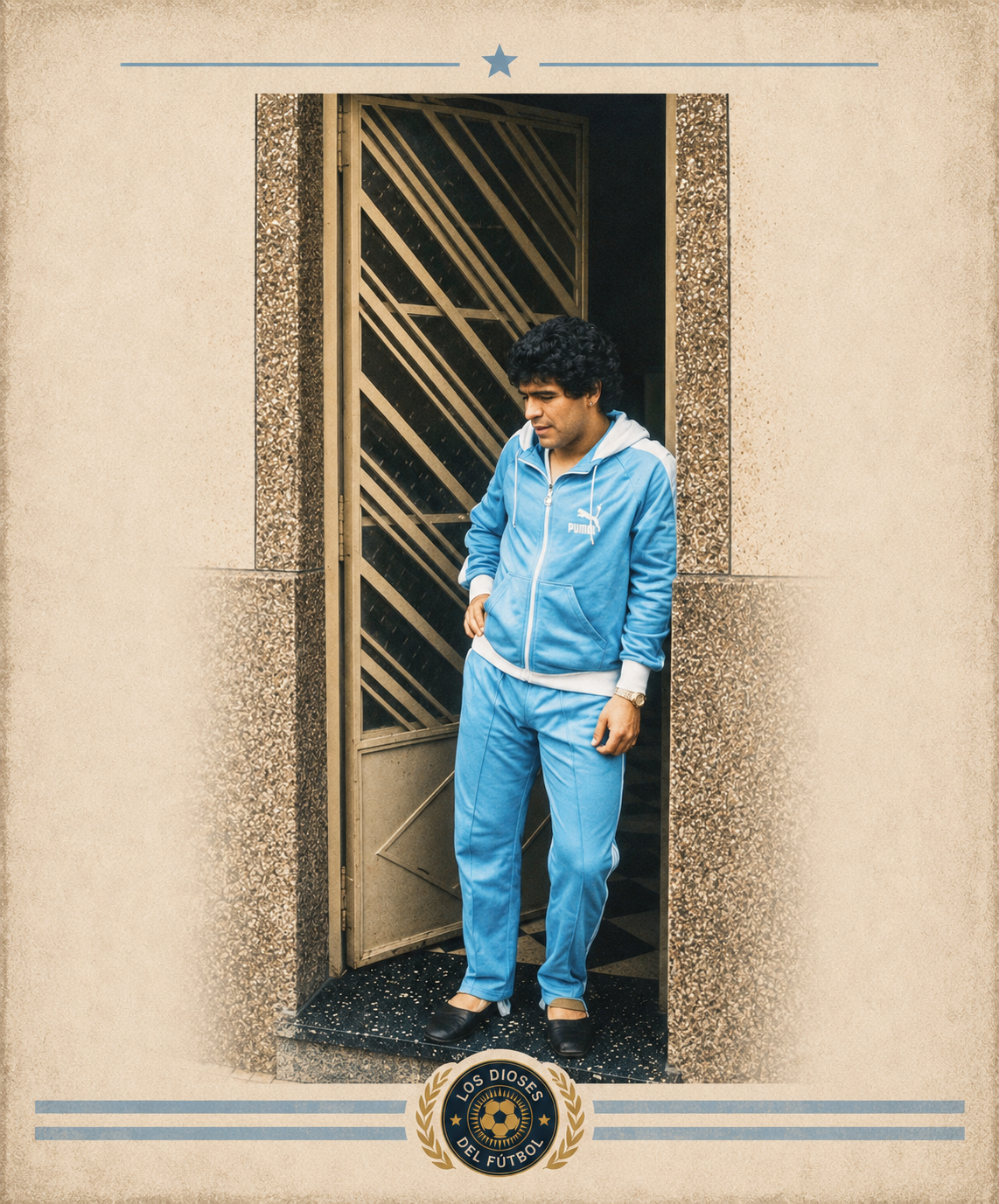
A god made flesh is still flesh, and flesh fails. The same Naples that crowned him had a darker gift to offer, because the city was run in those years in no small part by the Camorra, the local mafia, and they liked their saint close. Cocaine was everywhere around him. He had carried a habit from Barcelona, and Naples did not so much enable it as wrap it in velvet. The greatest footballer alive was getting through his days on a chemical that was quietly eating him, and the people who should have protected him had every reason not to.
For a while the talent papered over everything, the way talent does until suddenly it cannot. In 1991 he tested positive for cocaine and was banned from football for fifteen months. The fairy tale in Naples ended in disgrace and he left under a cloud that never fully lifted. The body that had defied gravity and physics and six foot goalkeepers turned out to be as breakable as anyone's, and the descent, once it started, was hard to watch.
There was one more act of self-destruction left at the very top. At the 1994 World Cup in the United States he looked, briefly, reborn. He scored against Greece and ran to a pitchside camera and screamed into the lens with his eyes bulging, a celebration that thrilled and unnerved in equal measure. Then he failed a drug test, this time for ephedrine, and was thrown out of the tournament and out of international football for good. The last image of Maradona the player was of a nurse leading him off a pitch by the hand, the god escorted away like a patient. It was the saddest thing.
What followed was a long unravelling that the whole world watched, because he never learned to live quietly. Cocaine, alcohol, ballooning weight, heart trouble, a near fatal collapse in 2000, treatment in Cuba where he befriended Fidel Castro and added a few more contradictions to a life already overflowing with them. He survived things that should have killed him several times over, which only deepened the myth, because every recovery looked like a resurrection. The man kept dying and kept coming back, and a watching world half expected he always would.
He was all too human in the end, and that is not a flaw in the story. It is the story. You cannot have a fall without a height to fall from, and you cannot have a god worth worshipping who never bleeds.
The Church of Maradona
In 1998, on Maradona's thirty eighth birthday, three fans in the Argentine city of Rosario decided that the obvious thing to do with a man like this was to start a religion. Hernán Amez, Alejandro Verón and Héctor Campomar founded the Iglesia Maradoniana, the Church of Maradona, and what began as a joke between friends who expected maybe forty members has grown into a faith with a claimed congregation in the hundreds of thousands across more than a hundred and thirty countries.
It is, on paper, a parody. Verón has said as much, that he has a rational religion which is Catholicism and a religion of the heart which is Diego. But spend any time with it and the line between parody and devotion stops being so easy to find, because the believers are not really joking, and neither, quite, are you by the end.
The church keeps its own calendar. The years are counted not from the birth of Christ but from the birth of Diego in 1960, so that the faithful live in the year After Diego rather than Anno Domini. His birthday, 30 October, is their Christmas. Their Easter falls on 22 June, the day of the two goals against England, because of course it does, because that was the day the miracle happened. New members are baptised by re-enacting the Hand of God, punching a ball into a net in imitation of the holy moment, which is either blasphemy or genius depending entirely on how seriously you have decided to take any of this.
And there are Ten Commandments. The ball must never be soiled. Love football above all things. Declare unconditional love for Diego and the beauty of the game. Defend the Argentina shirt. Spread the news of Diego's miracles throughout the universe. Honour the pitches where he played and the shirts he wore. Do not proclaim Diego as the property of any single club. Preach the principles of the church. Take Diego as your middle name, and give it to your firstborn son. They are absurd and they are sincere and they manage to be both at once, which by now you will recognise as the only register in which any of this works.
This is the genius of the man as an object of faith. He provided the deity with a working theology. There is a god in Diego, in the literal wordplay the church loves, the digits of his shirt number folded into the Spanish for God so that ten becomes Dios becomes D10S. There is scripture, his own memoirs, titled with characteristic modesty I Am El Diego of the People. There is a miracle, dated and filmed and watchable on demand. There is a fall and a long penance and a death still to come. The fans did not have to invent anything. They just had to notice that all the raw materials of a religion were sitting there in one short, brilliant, doomed Argentine, and write them down.
What has Jesus done, the believers like to ask, that Maradona hasn't. It is meant to provoke, and it does, and underneath the provocation there is a question the church cannot quite stop asking in earnest.
Death and Resurrection
On 25 November 2020 Diego Maradona died of a heart attack at his home on the outskirts of Buenos Aires, two weeks after surgery on a blood clot in his brain. He was sixty years old. He had been dying slowly for thirty years and then, finally, he did it all at once.
Argentina stopped. The president declared three days of national mourning and the body lay in state at the Casa Rosada, the pink presidential palace, where the dead are usually heads of state rather than footballers, except that in Argentina the distinction had never really existed for this one man. Hundreds of thousands queued through the streets of Buenos Aires to file past the coffin. The professional league renamed its cup competition after him within hours. A nation that had spent decades loving him and being exasperated by him in equal measure put both feelings down for a moment and simply grieved.
In Naples the grief was, if anything, deeper. The mayor stood up almost immediately and proposed renaming the stadium, and within days the Stadio San Paolo, named for the apostle Paul who legend says came ashore nearby, was the Stadio Diego Armando Maradona instead. A city swapped a saint for a footballer on its biggest building and did not consider it a downgrade. The murals were lit with candles. People who had been children in 1987 stood and wept in the streets for a man most of them had never met, because he had given their grandparents something to be proud of and that gift had outlived him.
Here is the thing about gods, though, the structural thing, the reason the timing matters. A religion is not complete without a death. The figure has to be lost before he can be venerated properly, has to pass out of the flawed and frustrating present and into the fixed and perfect past where he can never disappoint anyone again.
Alive, Maradona was a problem, an addict and an embarrassment and a man who kept turning up bloated and incoherent at the worst possible moments. Dead, he is finished, complete, untouchable. The body that failed him so publicly is gone and only the legend remains, and the legend does not do drugs or fall over or say the wrong thing on television. The death did not end the worship. It removed the last obstacle to it.
He is more worshipped now than he was on the day he died. That is not how it works for footballers. It is exactly how it works for gods.
The Verdict
So what do you do with him. You cannot file him under greatest, because greatest is an argument about football and Maradona stopped being only about football somewhere around the 55th minute at the Azteca. You cannot file him under flawed genius, because the phrase is far too small and far too polite for what he actually was. The flaws were not a footnote to the genius. They were made of the same stuff, poured from the same impossible source, and you do not get the genius without them. The hand that punched the ball past Shilton and the feet that danced through England belonged to the same restless, reckless, ungovernable man, and so did the nose that ruined him.
The footballing perfectionists will always prefer their saints clean. They will take Pelé's three World Cups or Messi's silent mastery, the careers without asterisks, the men who never made you wince. That is a reasonable taste and it is also, frankly, a slightly bloodless one, because it asks of a footballer only that he be the best and never that he be everything.
Maradona was everything. He was the best and the worst, the miracle and the disgrace, the patron saint and the cautionary tale, and he was all of it at full volume and at the same time, and he never once apologised for any of it.
That is why there is a church. Not because he was the greatest, though he might have been. Not because he was the most gifted, though he might have been that too. There is a church because he was the only footballer who ever managed to be genuinely divine, which is to say genuinely impossible, a creature of pure contradiction who blessed and betrayed in the same afternoon and made his people love him more for it. You do not build an altar to perfection. You build it to a god, and a god, properly understood, is a beautiful disaster you cannot stop believing in.
Diego Armando Maradona, 1960 to 2020. Born in the mud, buried like a president, worshipped like a god, and still, somewhere in Rosario, the only man in history whose Easter falls on the day he cheated England.