
The Furnace of Guadalajara: France, Brazil and the Greatest Game Nobody Won
The sun sat directly overhead when the finest footballers of their age walked out at the Estadio Jalisco, and there was nowhere in all of Guadalajara to hide from it.
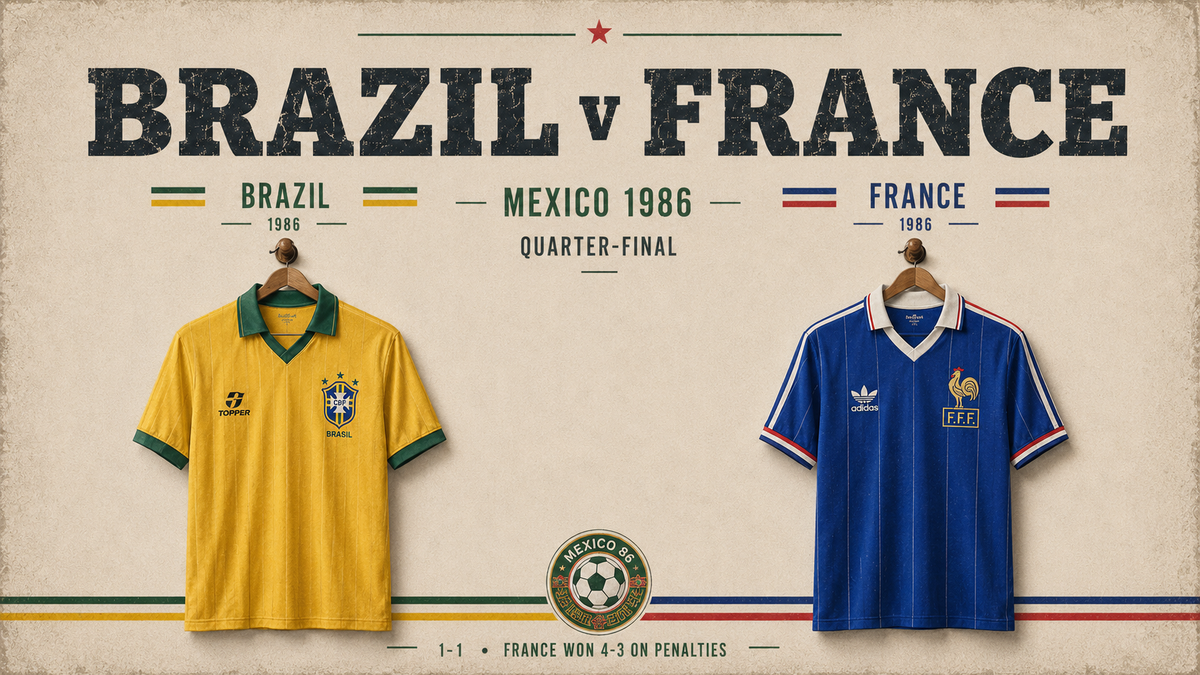
The 1986 World Cup quarter-final at the Estadio Jalisco had noon heat, a penalty shootout and the end of Brazil's golden generation.
The sun sat directly overhead when the finest footballers of their age walked out at the Estadio Jalisco, and there was nowhere in all of Guadalajara to hide from it.
It was 21 June 1986. Kick off was set for noon, an hour chosen not for the players but for the television sets of Europe, and the city sits almost a mile above the sea, where the air is thin and the heat presses down like a hand. The thermometer read somewhere around thirty six degrees. Into this furnace walked Brazil and France, two of the most gifted teams ever assembled, and over the next two hours they produced something that men who were there still talk about in hushed tones.
Pelé called it the match of the century. He was not given to understatement, but on this occasion the hyperbole barely covered it.
Sixty five thousand people filled the Jalisco, and the overwhelming majority of them had come to see Brazil. They had reason to believe. This was a Seleção carrying the weight of unfinished business, the survivors of a heartbreak four years old and a continent's worth of expectation. To understand why the heat of that afternoon mattered so much, you have to understand what both teams were chasing, and what they had already lost.
Brazil arrived in Mexico to settle a debt with history. The team of 1982 had been the most beautiful thing in the sport, a midfield of Sócrates, Zico, Falcão and Toninho Cerezo that played as if the ball were a thing to be cherished rather than merely controlled. They had gone to Spain as the romantics' champions and come home beaten, undone 3-2 by Paolo Rossi and a more ruthless Italy in a second round group game still mourned as one of the great injustices of the football imagination. They scored beauty. Italy scored goals. Telê Santana, the coach who built that side and believed in its creed to the last, was given one more attempt in Mexico. He kept faith with his ageing artists. Zico, Sócrates and Junior were all there again, four years older, a little slower, carrying knocks and the knowledge that this was almost certainly the final reel.
Across the halfway line stood France, and the French had their own myth to chase. Le Carré Magique, the Magic Square, was the most celebrated midfield on earth. Michel Platini, Alain Giresse, Jean Tigana and Luis Fernández had won France the European Championship on home soil in 1984, Platini scoring in a torrent that summer, and they had come to Mexico as champions of Europe rather than gallant losers.
They had already dispatched the holders Italy 2-0 in the previous round, a quiet act of revenge on Brazil's behalf as much as their own. Platini himself was turning thirty one that very afternoon, the first man to play a World Cup match on his birthday twice, and he was doing it through the dull ache of tendonitis. Genius on a bad knee, in the noon sun, almost a mile high. The whole match was built on men asking their bodies for one last impossible favour.
What followed was not a war of attrition, which is the strange and wonderful part. In conditions that should have produced a cautious, leaden stalemate, the two sides went at one another with a speed and a daring that defied the thermometer. Brazil struck first. On seventeen minutes a sweeping move flowed through Müller and Junior and ended with Careca, the tournament's coming man, finishing crisply from inside the area. It was his fifth goal of the World Cup and it sent the Jalisco into raptures.
For a long stretch Brazil looked the better team. They rattled the French woodwork. They threatened to put the game out of reach before the interval. Carlos, the Brazilian goalkeeper, had not conceded for four hundred minutes, a new national record stretching back to the first whistle of the tournament, and the wall looked like holding.
Then, four minutes before half time, it cracked. A French move down the right took a deflection off Júlio César, the ball squirmed loose in the six yard box, and Platini arrived at the far post to tuck it in. It was a scruffy goal for so refined a footballer, a tap in born of a deflection rather than a flourish, but it ended Carlos's record and levelled the match and reminded everyone that France would not go quietly. They walked off at the interval at 1-1, into the only shade they would see for the next hour, and out they came again into the white glare.
The second half belonged to nerve as much as talent. Brazil pressed. Careca headed against the bar. Santana, sensing the moment, sent on Zico just past the hour, the prince of the 1982 side reduced now to a substitute's role, his body no longer to be trusted for ninety minutes. Within two minutes of arriving he conjured a pass of pure silk with the outside of his boot to release Branco, who was hauled down by the onrushing Joël Bats.
Penalty to Brazil.
The chance to win it, handed to the man who many believed should have been a world champion already. Zico took the ball himself. He had been on the pitch barely two minutes, his muscles cold against the heat of everyone else's afternoon, and his penalty was struck at a comfortable height for Bats, who guessed correctly and saved. The miss hung over everything that came after.
Nobody scored in the remaining minutes, and nobody scored in extra time, though both teams had chances to end it. Two more half hours of running in that heat, men in their thirties dragging themselves through a hundred and twenty minutes at altitude with the sweat long since wrung out of them, and still the football kept its quality. When the whistle finally went it stood at 1-1, and the most beautiful match of the tournament would be settled by its cruellest mechanism.
The penalty shootout at the Jalisco is one of the most famous in the history of the World Cup, and it is famous because of who missed. Sócrates went first for Brazil. The captain, the doctor, the man with the headband and the philosopher's name, the most recognisable footballer on the planet that summer, walked the long walk to the spot and saw his penalty saved by Bats.
It was a wound the rest could not quite close. The next six kicks all found the net, Brazil and France trading goals through Alemão and Stopyra, through Amoros, through Zico atoning for his earlier miss, through Bellone and Branco, the shootout level and unbearable.
Then Platini stepped up.
The king, on his birthday, with the chance to put France ahead. He blazed it high over the bar and into Guadalajara folklore, and still jokes that they are looking for the ball to this day. A reprieve for Brazil. But Júlio César could not take it. His kick was kept out, and that left Luis Fernández, the youngest of the Magic Square, to settle four decades of footballing argument with a single swing of his boot. He scored. France had won 4-3 on penalties. Brazil's golden generation was finished.
What happened next is almost as remembered as the football. There was no rancour. Jean Tigana swapped shirts with Sócrates and would later admit that watching a documentary about the Brazilian years afterwards brought tears to his eyes. The French players knocked on the door of the Brazilian dressing room, expecting to be told where to go, and instead were welcomed in by men who were utterly devastated and entirely without bitterness.
Giresse called it the most spectacular game he ever played in. Bats said they were honoured simply to have shared a pitch with that Brazil. It was the rarest kind of defeat, the kind that ennobles the beaten as much as the victors.
For Brazil the reckoning was immediate and heavy. Telê Santana walked out of the stadium and told reporters he was no longer in love with football, that he would only coach again if he needed the money. Junior, surveying the wreckage of two World Cups, said simply that his generation were not meant to be champions. Zico never played another official match for Brazil.
And Sócrates, the captain, had pulled on the yellow shirt for the last time. He would play on at club level for another three years, flashes of the old brilliance still visible even as his body began to fail him, but his Seleção story ended there in the Jalisco heat, with a saved penalty and a shirt handed to a Frenchman.
It is worth lingering on him, because he was the soul of that side and because the manner of his goodbye carried a poignancy that the years have only deepened. Sócrates was not built like a footballer. He stood well over six feet tall, slender and almost languid, and he played the game at a tempo entirely his own, the unhurried passes, the famous backheel, the sense that he saw two moves further than anyone around him.
Pelé is supposed to have said that Sócrates played better going backwards than most players managed going forwards. He was also a qualified doctor, an intellectual who quoted philosophy and smoked and drank and refused on principle to keep his politics off the pitch. At that 1986 World Cup he wore a white headband, partly as defiance and partly in solidarity with the victims of the Mexico City earthquake that had flattened parts of the host nation the year before.
What he stood for at Corinthians, and the democracy he helped build inside a football club under a military dictatorship, is a story that deserves its own telling and will get one. For now it is enough to say that when he walked to take that first penalty, he carried more than a nation's hopes on his shoulders.
He died in 2011, aged just fifty seven, his body worn down by the same appetites that made him such a vivid presence in life. He had once said that while he was a footballer his legs amplified his voice. In Guadalajara those legs carried him through a hundred and twenty minutes of the most demanding football imaginable, in heat that would floor most men inside a quarter of an hour, before they finally failed him at the penalty spot. There is something almost unbearably fitting about it, the great romantic undone not by a lesser team but by the sheer cruelty of the contest he loved.
That is the thing about the men of the Jalisco, on both sides. They were asked to do something that modern football would consider close to inhumane, and they did it without complaint and with breathtaking grace. A noon kick off. Thirty six degrees. Thin mountain air. A hundred and twenty minutes on the clock. One interval at half time and nothing else, no pause wheeled out for hydration, no engineered window in which to gather a breath. They ran until they could not run, and then they ran some more, and the football never stopped being beautiful.
Forty years on, in another World Cup played across the same continent, we halt matches every twenty two minutes so that the players might sip water and, not coincidentally, so that a brand might have its moment on the screens above. The gods of Guadalajara were offered no such interval, and you suspect they would not have wanted one. They had a World Cup to lose with the ball at their feet, and not a single second to spare for the man with the drinks tray.
Dios del Fútbol is part of the Headers and Volleys Fanzine Network