Uruguay World Cup History: The Smallest Giant in 2026
Uruguay won two World Cups and two Olympic golds. Explore La Celeste's history and what Bielsa's side can chase at World Cup 2026.
Two Olympic golds, two World Cups, four stars, and a 76-year wait. Inside La Celeste's glorious past and what Bielsa's side can realistically chase in North America.
There is no fairer way to start than with the arithmetic, because the arithmetic is absurd. A country of roughly three and a half million people, smaller than greater London, has been world champion of football twice and Olympic champion twice. Those four titles are why La Celeste wear four stars above the crest while nations ten times their size make do with none. Uruguay did not stumble into greatness. They invented the habit of winning before most of the world had worked out the offside rule.
The years they owned the world
The legend begins not at a World Cup but at the Olympics. In 1924 a Uruguayan side captained by José Nasazzi, the defender they called El Gran Mariscal, crossed the Atlantic by boat and took gold in Paris. Four years later in Amsterdam they did it again. In an era when the Olympic football tournament was the closest thing the planet had to a world championship, those two golds were world titles in everything but name, and FIFA counts them as such to this day. That is the secret behind the four stars: two Olympic crowns, two World Cups, one continuous line of pedigree.
Then came 1930. The inaugural World Cup was handed to Uruguay, partly as a reward for that Olympic dominance and partly to mark a century of independence. They built the Estadio Centenario in Montevideo for the occasion and won the thing on home soil, beating Argentina in the final. The smallest of nations had hosted and conquered the first tournament of its kind.
The second triumph is the one that still echoes loudest. By July 1950 Brazil had treated the final pool as a procession, thrashing Sweden 7-1 and Spain 6-1, and the deciding match at the Maracanã was less a fixture than a coronation waiting to happen. Brazil needed only a draw; Uruguay had to win. The newspapers had printed the celebration headlines, a victory song was ready, and a commemorative medal had already been struck. Nearly two hundred thousand people packed the stands on the afternoon of 16 July expecting to watch history confirm itself.
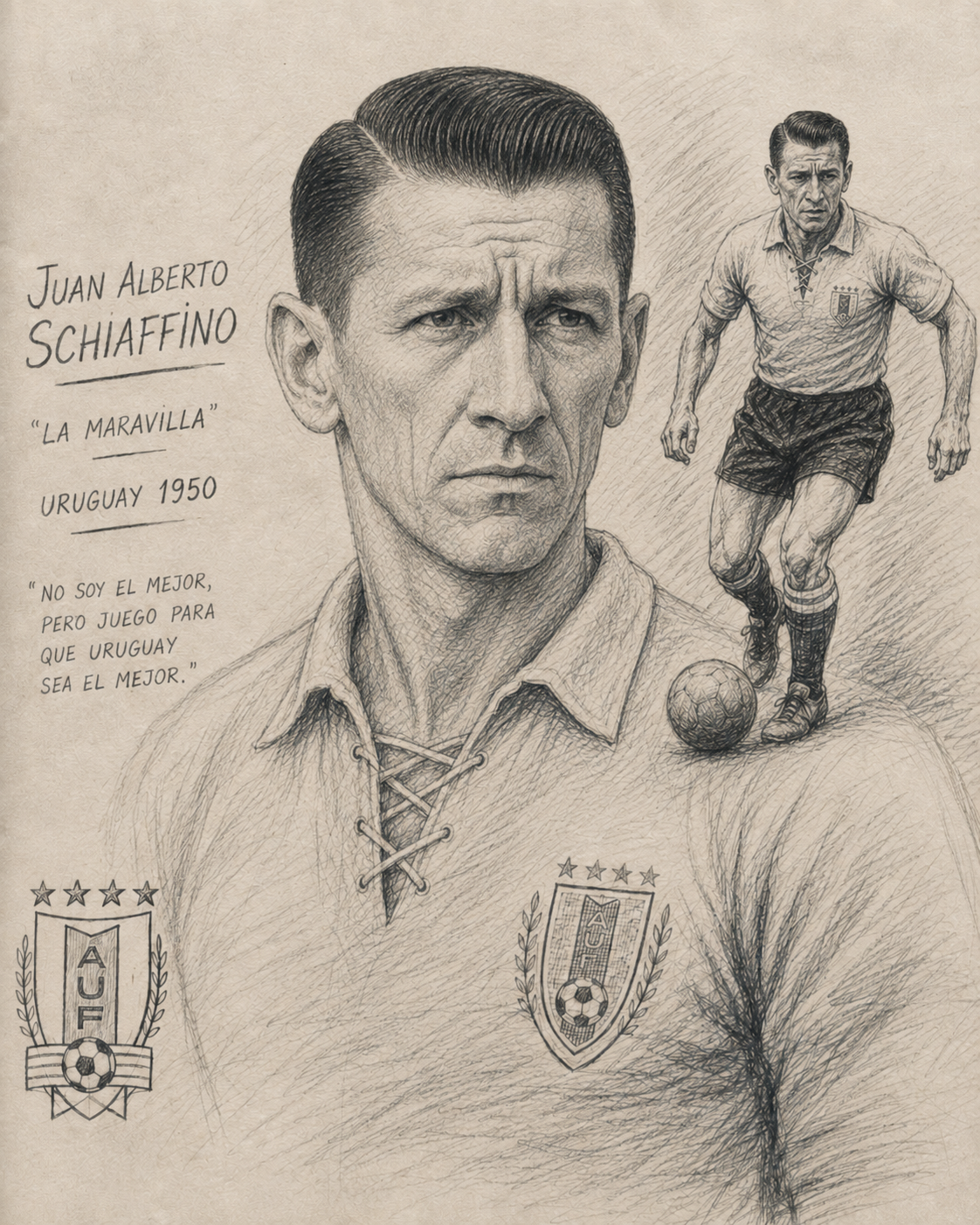
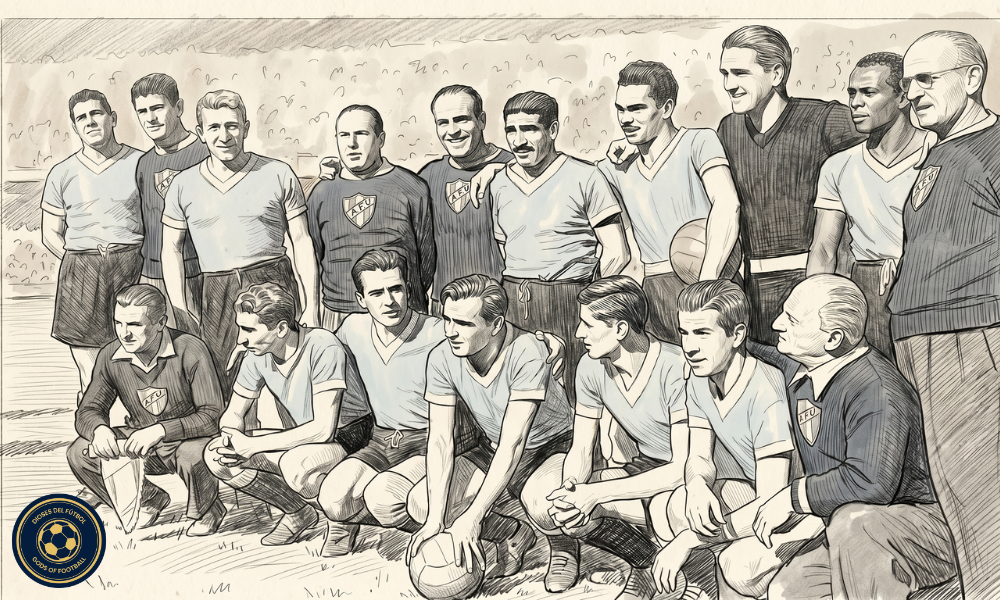
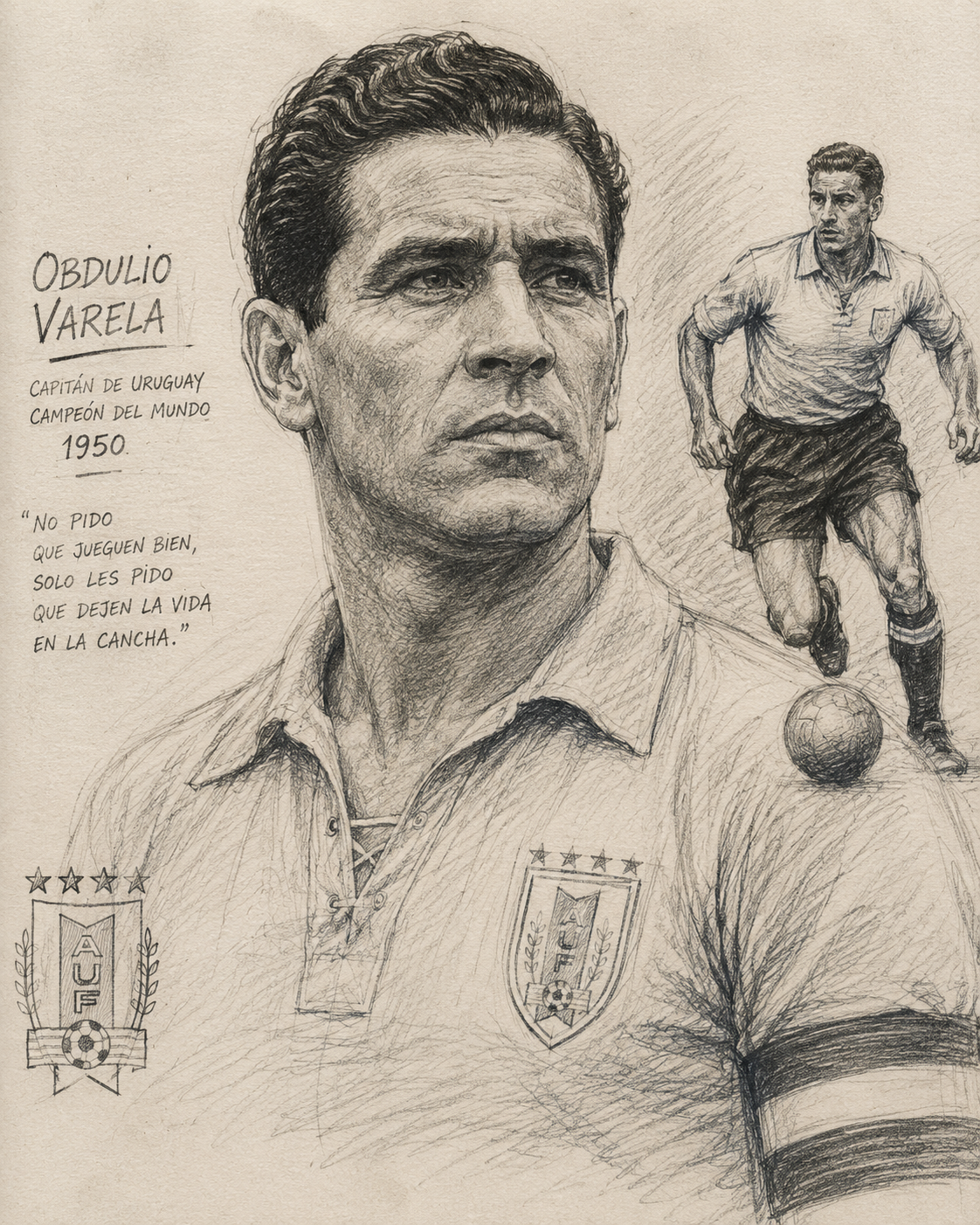
The man holding Uruguay together was their captain, Obdulio Varela, a granite-jawed centre-half they called El Negro Jefe, the Black Chief. Around him coach Juan López built a side whose spine came from Peñarol: goalkeeper Roque Máspoli behind him, the elegant inside-forward Juan Alberto Schiaffino pulling the strings, and a quicksilver 23-year-old winger named Alcides Ghiggia on the right. Ghiggia had already scored in all of Uruguay's matches up to that point.
Completing the XI were defenders Matías González and Eusebio Tejera, the half-backs Schubert Gambetta and Víctor Rodríguez Andrade flanking Varela, and a forward line of Ghiggia, Julio Pérez, Óscar Míguez, Schiaffino and Rubén Morán.
For a goalless first half Brazil battered the Uruguayan goal and somehow did not score. A minute into the second half they finally broke through, the forward Friaça turning it home to send the stadium into delirium. This was the moment the match turned, though not in the way the crowd assumed. Varela grabbed the ball, walked it slowly back to the centre circle, and began arguing with the referee, stalling, deliberately draining the noise and the momentum out of the ground. He gathered his rattled teammates and told them, simply, that now it was time to win. The famous line attributed to him, that the crowd was made of paper, captured the same defiance: do not be afraid of two hundred thousand people.
They were not. Midway through the half, Varela found Ghiggia on the right, where Brazil's left-back Bigode had given him room. Ghiggia danced past him and crossed for Schiaffino, who headed the equaliser past goalkeeper Moacyr Barbosa. Then, with eleven minutes remaining and the score level, Ghiggia surged down the same flank, and rather than cross again drove a low shot past Barbosa at his near post to make it 2-1. A silence so total it became legend fell over the Maracanã. Uruguay held on. They had won their second World Cup, on enemy soil, in front of the largest crowd the game had ever seen.
The wounds never fully closed for Brazil. Barbosa was branded the man who lost the World Cup, played only once more for his country, and decades later was turned away from the national team for fear he carried bad luck. Even Brazil's all-white kit was abandoned as cursed and replaced by the now iconic yellow and blue. Ghiggia, for his part, spent the rest of his life as a national hero on the other side of the result, and summed up his goal with the sentence every Uruguayan can still recite: only three people, he said, had ever silenced the Maracanã, the Pope, Frank Sinatra, and him.
Since that afternoon, the glory has been measured in near misses. Three times Uruguay have reached a World Cup semi-final and three times fallen short, the most recent and most romantic being the run to the last four at South Africa 2010. They remain South America's most decorated side in the Copa América, with fifteen continental titles. But the World Cup itself has stayed out of reach for seventy six years, which is the precise weight every Uruguayan squad now carries to a tournament.
Uruguay's 2026 World Cup Hope
Which brings us to North America, and to a side that arrives carrying both that history and a particular kind of pressure. Uruguay qualified the hard way, finishing fourth in the brutal CONMEBOL standings on twenty eight points, level with Colombia, Brazil and Paraguay before goal difference sorted them out. The team sits around seventeenth in the FIFA rankings, which feels both about right and faintly insulting to a nation with their record.
In charge is Marcelo Bielsa, the obsessive Argentine whose football demands everything from a player's lungs and legs. This is his first World Cup with Uruguay, though he knows the stage well, having guided his native Argentina to Olympic gold in 2004. His side has been drawn into a genuinely awkward Group H alongside European champions Spain, Saudi Arabia and tournament debutants Cape Verde. The schedule opens against the Saudis in Miami on June 15, continues against Cape Verde, and closes with the heavyweight collision against Spain in Guadalajara. Few groups offer such a clear ascent in difficulty.
The spine is serious. Federico Valverde, Real Madrid's relentless box-to-box engine, is the creative heartbeat and the player everything flows through. Behind him sits one of the planet's better centre-back pairings in Barcelona's Ronald Araújo and captain José María Giménez, who arrives on the verge of a hundred caps. Manuel Ugarte and Rodrigo Bentancur give the midfield muscle and metronome respectively. There are concerns, mind. Darwin Núñez is trusted to lead the line despite a thin run of club minutes, and the gifted playmaker Giorgian De Arrascaeta is racing back from a calf tear, hoping to feature later in the tournament.
Two decisions tell you what kind of Uruguay this is. Bielsa pulled 39-year-old Fernando Muslera out of international retirement, handing him a record-breaking fifth World Cup. And in the same breath he left out Luis Suárez, the all-time top scorer, who will miss a World Cup for the first time since 2010. It is a squad caught between reverence for the old guard and the cold logic of a coach who trusts profiles over reputations.
Tempering all of it is a sobering recent friendly, a 5-1 hammering by the United States that left Bielsa publicly ashamed and calling for calm. That scoreline is the gap between the dream and the present. Uruguay are not favourites. They are unlikely to lift a third star this summer. But they have a coach who terrifies opponents on his day, a midfield that can strangle a match, and a footballing soul forged in the belief that the crowd is always made of paper. For a nation that has spent a century proving that size is the least interesting thing about a football team, that may be enough to be dangerous once again.
Dios del Fútbol is part of the Headers and Volleys Fanzine Network.