Maradona's Hand of God and Goal of the Century, Mexico 86
Maradona at Mexico 86: the Hand of God, the Goal of the Century and four minutes at the Azteca that turned a boy from Villa Fiorito into a god.
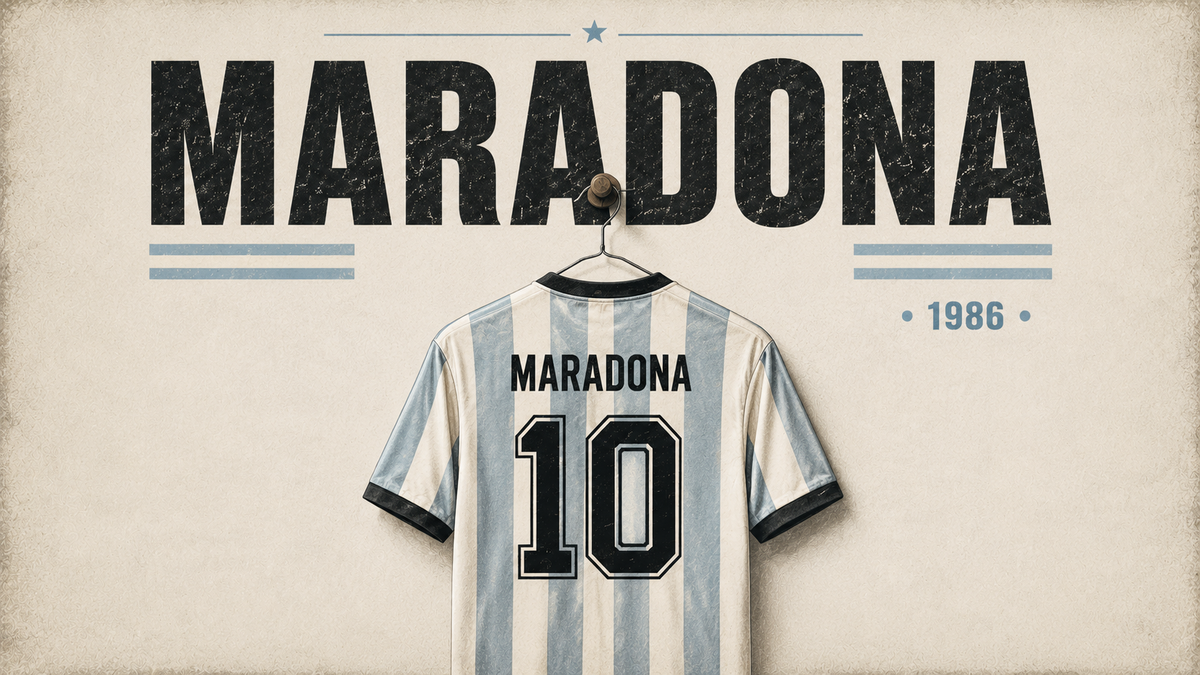
A fist, a miracle and 240 seconds at the Azteca. The first profile in our pantheon could only ever be Diego Maradona
The first profile in our pantheon. Where else could we begin?
This site is named for the gods of football, so we should be honest about what a god actually is. Not a saint. The old gods were never saints. They cheated, they raged, they seduced, they punished, and they performed miracles, sometimes all in the same afternoon. By that definition, the ancient one, football has produced exactly one true god, and on 22 June 1986, in the thin air of the Estadio Azteca, he revealed both of his faces inside four minutes.
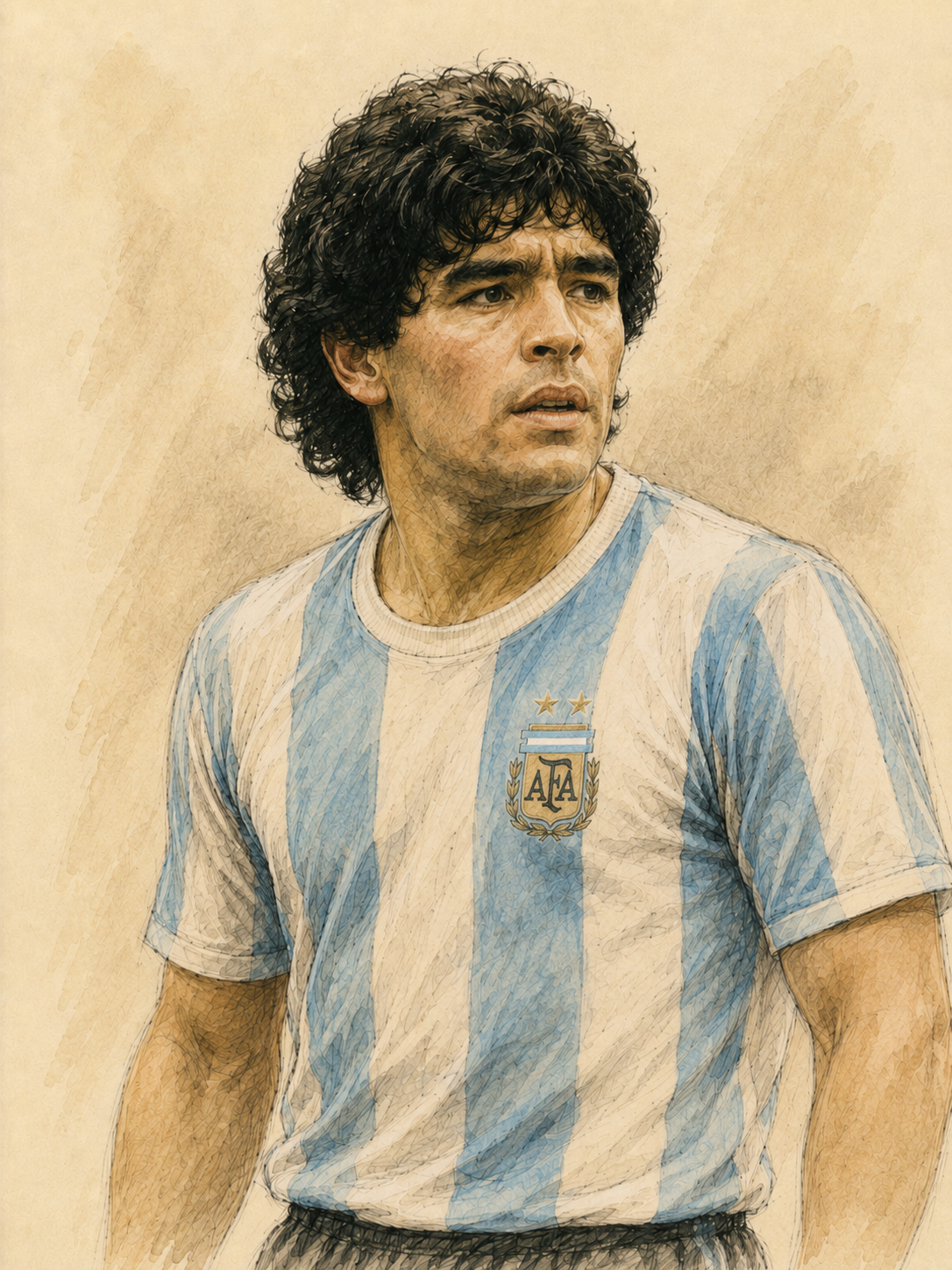
Diego Armando Maradona was born in 1960 in Villa Fiorito, a barrio on the southern edge of Buenos Aires where the streets flooded when it rained and the football pitches were dust and broken glass. The story goes that he fell into a cesspit as a small boy and his uncle pulled him out shouting at him to keep his head above the filth. Argentina has been telling that story for sixty years because it is the whole man in miniature. Diego spent his life up to his neck in it and never once stopped looking up.
The ball was his escape and his weapon. At nine he was performing keepy uppies at half time of Argentinos Juniors matches, a tiny street magician the crowd refused to let leave. At fifteen he made his first division debut, and with his first touch he nutmegged an opponent, which tells you everything about what he believed football was for. It was never simply about winning. It was about humiliation and joy, the two great currencies of the potrero. He scored 115 goals for Argentinos before Boca Juniors, the club of his heart and his class, paid £1 million for him in 1981. He gave La Bombonera one season and one league title, and the old ground has been trembling with his absence ever since.
Then came Europe, and Europe did not deserve him yet. Barcelona paid a world record £5 million in 1982 and got two seasons of brilliance interrupted by hepatitis, by the savagery of Andoni Goikoetxea, whose tackle in September 1983 broke Diego's ankle and very nearly his career, and finally by the brawl at the 1984 Copa del Rey final, when Maradona, taunted one time too many, started a riot in front of the king. Barcelona is a cathedral, and cathedrals have rules. Gods born in the mud do not do well with rules. So they sold him, for another world record, £6.9 million, to the one city on earth that would understand him completely.
Naples did not buy a footballer in the summer of 1984. Naples bought a redeemer. Seventy five thousand people came to the San Paolo just to watch him wave. This was the poorest great city in Italy, sneered at by the rich north, told in away end banners that it was the sewer of the country, and here was a poor boy from a flooded barrio who took all of that contempt personally. He carried Napoli to the first scudetto in their history in 1987, then a second in 1990, a UEFA Cup and a Coppa Italia in between, and he did it while the city built shrines to him in the alleyways. Actual shrines. Candles, glass cases, strands of his hair. Theology, not fandom.
But the temple of temples is the Azteca, and the holy day is 22 June 1986.
Understand what that quarter final was. Four years earlier Argentina and Britain had fought a war over the Malvinas, and hundreds of young Argentine men, conscripts the same age as the players, never came home. Maradona later admitted the squad talked of nothing else. It was a football match the way a storm is weather. And into it walked a 25 year old at the absolute peak of his powers, captain of his country, with a grievance the size of the South Atlantic.
The first goal came six minutes into the second half, and it was a crime. Steve Hodge sliced a clearance into his own box, Maradona kept running, and as Peter Shilton rose to claim it, a man eight inches shorter somehow got there first, with a fist disguised as a forehead, and flicked the ball into the net. The referee saw nothing. Shilton has never forgiven it. Afterwards Diego smiled and said the goal had been scored a little with the head of Maradona and a little with the hand of God, which remains the most magnificent non confession in the history of sport.
The English call it cheating, and they are right. Argentina calls it viveza criolla, the cunning of the street, the art of the poor taking from the powerful what would never be given freely, and they are also right. This is the point about gods. They do not play by your rules. They make their own and dare you to do something about it.
And then, four minutes later, as if to prove the universe had a sense of structure, he scored the greatest goal the game has ever seen. He received the ball inside his own half, spun away from two men in one movement, and set off on a run of some sixty metres that took ten seconds and lasted forever. Beardsley. Reid, chasing like a man pursuing a bus that has already left. Butcher. Fenwick, who simply waved him through. Then Shilton, the same wronged keeper, sold the gentlest feint of all, and the ball rolled into the net while Terry Butcher arrived a second too late to do anything but witness it. In the commentary box Víctor Hugo Morales was weeping and asking the cosmic kite which planet he had come from. FIFA later put it to a global vote and the world confirmed what the Azteca already knew. The Goal of the Century, scored by the man who had picked your pocket four minutes earlier.
That is the profile, really. Both goals. You cannot have one without the other, and anyone who tries to separate them has missed the entire religion. The sinner and the genius shared a body, and the genius needed the sinner. The chip on the shoulder, the rage at every slight from every authority, the refusal to be small in a world that kept demanding it, that was the fuel for all of it.
He won the final too, of course. West Germany, 3-2, and with the score level and minutes left he threaded the pass for Jorge Burruchaga to win it. Five goals and five assists across the tournament, a hand in ten of Argentina's fourteen goals, a World Cup won by one man more completely than any trophy before or since.
The fall came, because it always does. The cocaine, the Camorra, the ban, the night in Naples in 1990 when he asked the city to choose him over Italy and broke something that never quite healed. Sent home from USA 94 in disgrace. Decades of hospital doors and comebacks. And when he died in November 2020, Argentina declared three days of mourning, Naples renamed its stadium within weeks, and millions of people who never saw him kick a ball wept in the street.
They painted him on walls from Buenos Aires to Nápoles, halo above his head, and nobody anywhere found it blasphemous. That is the test, in the end. Plenty of footballers have been called gods. Diego is the only one who got the iconography.
Even Saint Peter checked his hand at the gate. Just to be sure.
Check out the Dios 10 8 Bit Designs.
 Dios 10 8 Bit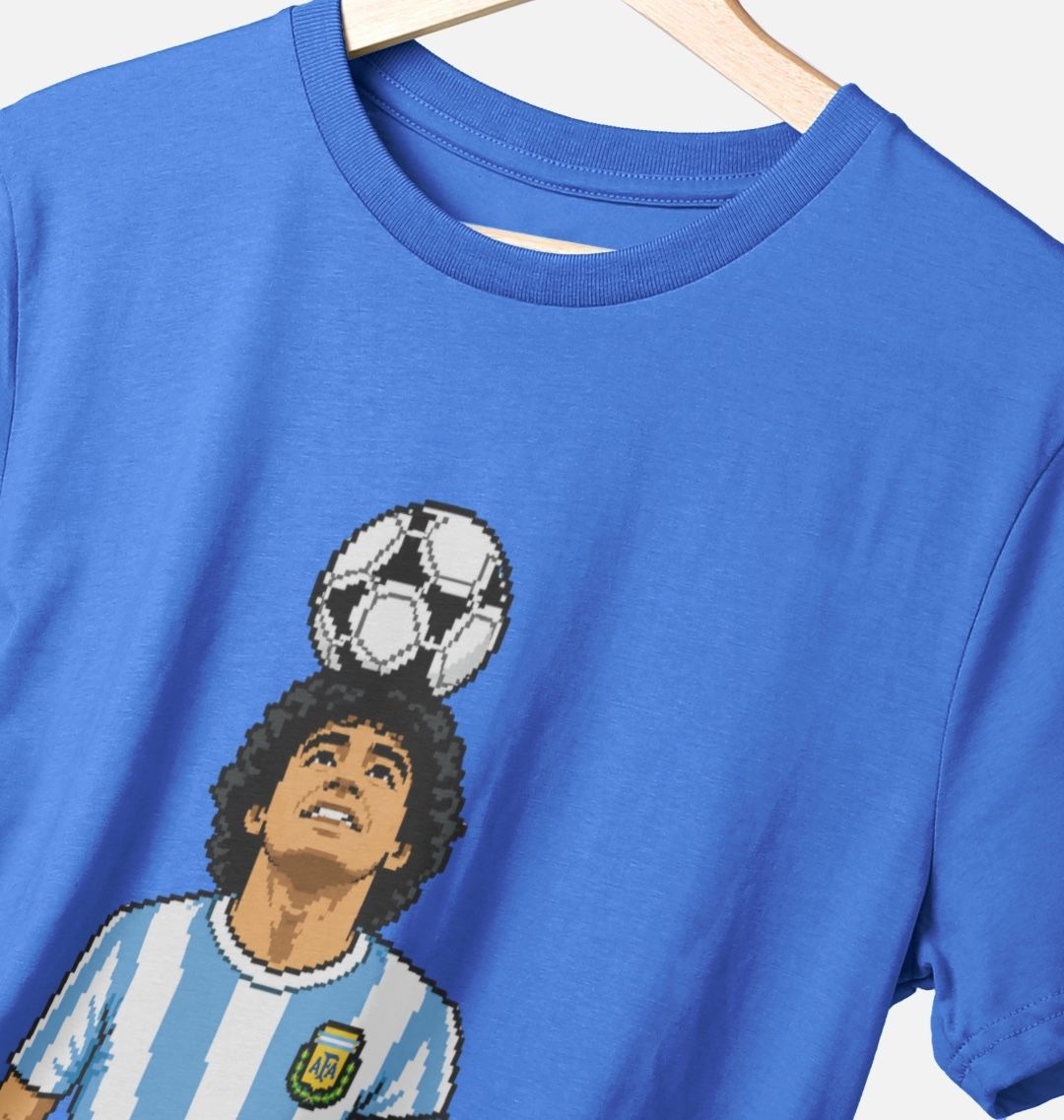
 Dios 10 8 bit 2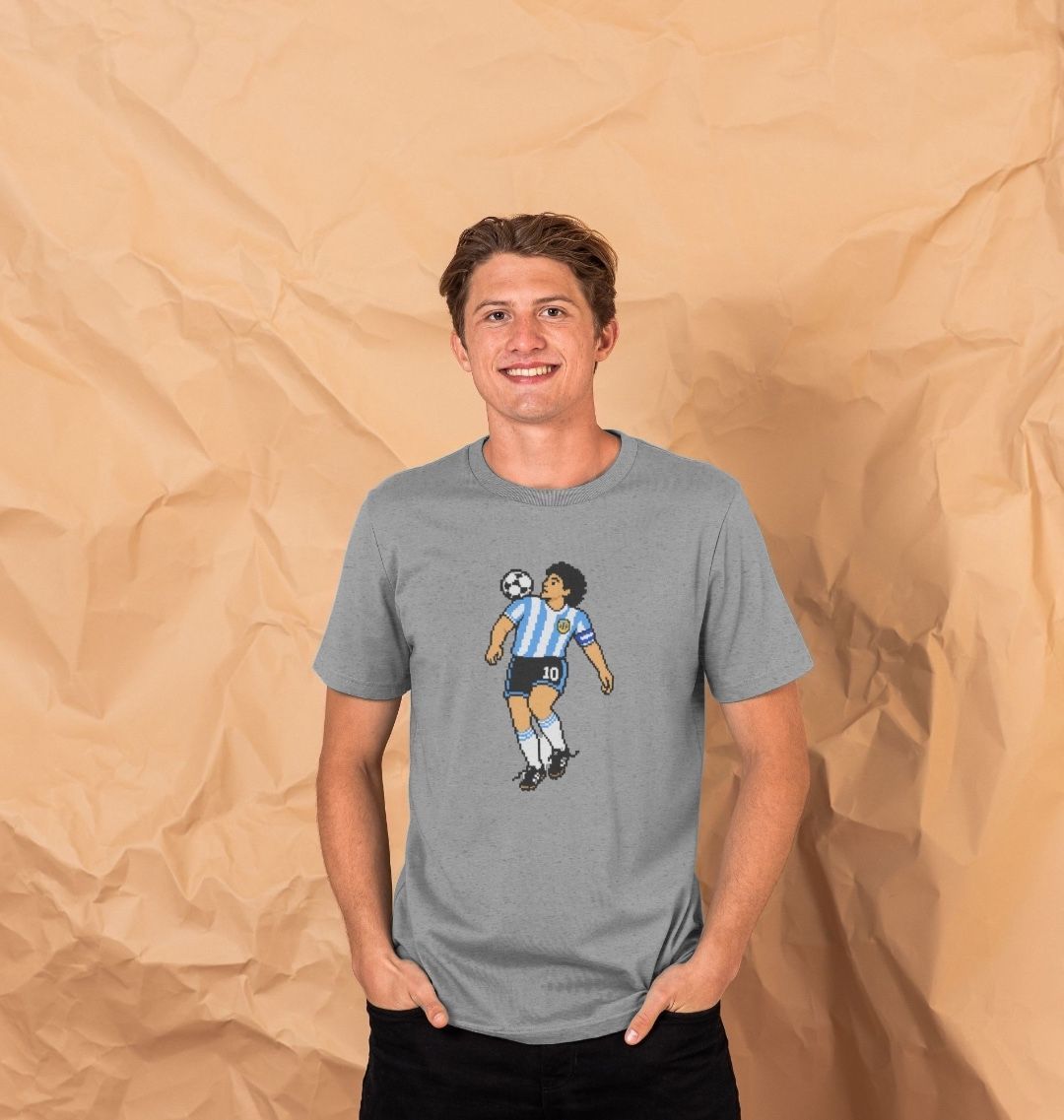
Dios del Fútbol is part of the Headers and Volleys Fanzine Network.