
The Cursed Prince: Heleno de Freitas and the World Cup That Never Came
This is the story of Heleno de Freitas, the cursed prince of Brazilian football, and the stage he was never once allowed to take.
He scored more than two hundred goals, won a single title and died forgotten in an asylum. The finest footballer Brazil never sent to a World Cup.
In the winter of 1958 a man who those around him swore looked closer to seventy than to forty sat in a sanatorium in the hills of Minas Gerais and learned that Brazil had finally won the World Cup. He was thirty eight years old. The syphilis had been in his blood for the better part of a decade and it had long since climbed into his brain. Some days he spoke to the nurses. Other days he sat in a wheelchair and stared out across the grass of the hospital grounds and said nothing at all. A teenager called Pelé had just lifted a trophy in Sweden that this man, in another life, the life he was supposed to have, might have lifted first.
His name was Heleno de Freitas. The Brazilians who remember him at all call him O Príncipe Maldito. The cursed prince. It is not a phrase a marketing department dreams up over coffee. It is the verdict of a country that watched a beautiful and gifted man set fire to himself in slow motion, and never quite forgave itself for enjoying the blaze.
Two dates hold his story the way two nails hold a portrait to a wall. The first is 16 July 1950, the afternoon the Maracanã was raised to crown Brazil and instead entombed them, the World Cup final Heleno was built to grace and never reached. The second is 29 June 1958, the day Brazil won the thing at last, in a country he would never see, while he sat broken and silent in Barbacena. Between those two dates lies the whole cruelty of him. He was the finest Brazilian footballer never to appear at a World Cup, and he arrived at that distinction not through misfortune alone but through a long and almost deliberate commitment to his own undoing.
The Birth of Heleno de Freitas
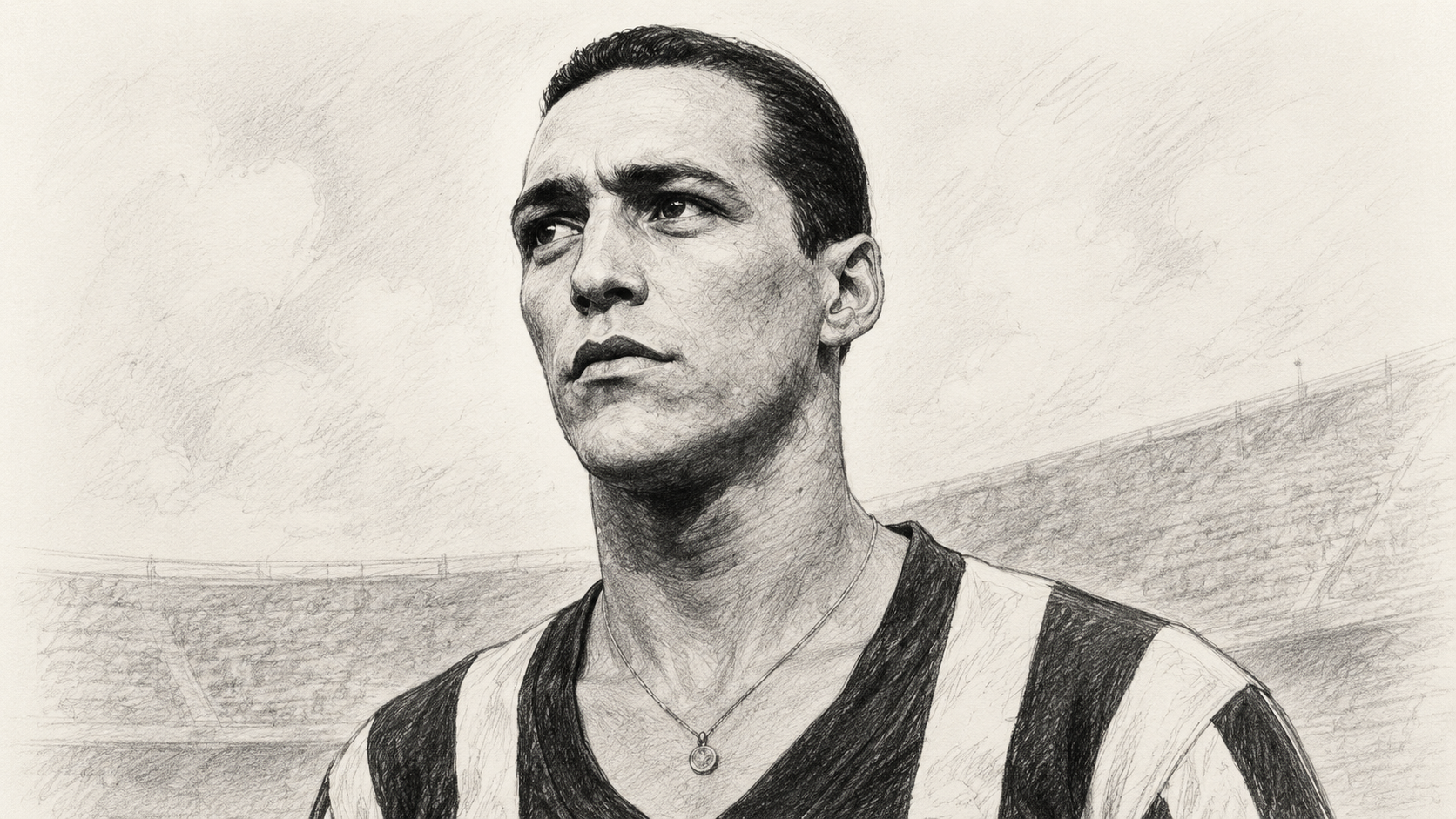
Begin at the beginning. Heleno de Freitas was born on 12 February 1920 in São João Nepomuceno, a small town in Minas Gerais, into a family with money and standing. This matters. The story of early Brazilian football is usually told as a story of barefoot boys on red dirt, of poverty turned into genius by sheer hunger. Heleno was the opposite of all that. He was a rich boy, well dressed, well spoken, raised to be somebody. After his father died the family moved to Rio de Janeiro, and in Rio the young Heleno did the respectable thing and went to study law. He finished the degree. He could have spent his life in a cool office near the bay, arguing contracts, growing comfortable, growing old.
He chose the ball instead. By his teens he was already at Botafogo, and from the moment he became a fixture in the side around 1939 and 1940 it was obvious the law had lost a clerk and the game had gained a king. He was tall and elegant and quick, and he had a header of the ball that men who saw it described for the rest of their lives. Most of his goals, the legend insists, came off his forehead, a striker who treated the high ball the way a poet treats a difficult line, as something to be finished cleanly and never wasted.
Heleno de Freitas scored an incredible 209 goals in 235 appearances for Botafogo between 1939 and 1948.
The numbers are extraordinary and, in the honest tradition of the period, slightly uncertain. The almanacs cannot quite agree, which is the surest sign that the man was real and the bookkeeping was casual. Somewhere over two hundred goals in something over two hundred and thirty games for Botafogo is as tight as the record will allow you to be. Most reckonings land on roughly two hundred and four to two hundred and nine goals across two hundred and thirty three to two hundred and thirty five matches.
Whichever ledger you believe, it works out at close to a goal every game across the better part of a decade, and it made him the fourth highest scorer in the club's history and the greatest idol Botafogo had before a bow legged boy from Pau Grande called Garrincha came along to change everything again.
To watch him, by the testimony that survives, was to watch a man who seemed to think the game beneath the effort most players gave it. He was a centre forward with the bearing of an aristocrat, all clean lines and disdain, and his heading was the thing nobody could quite believe.
He scored with his head from positions that should not have allowed it, hanging in the air a beat longer than the body ought to permit, meeting crosses the way a duellist meets a thrust. There are old reporters who insisted, long after he was gone, that on his day Heleno belonged in any conversation about the finest the game has produced, that the talent was the equal of anyone's and only the temperament and the appetites kept him out of the company of Pelé.
It is the sort of claim that cannot be settled and never stops being made, and that, in the end, is the whole problem of him. We are left arguing about a ghost.
What survives of Heleno is mostly words, because almost nothing else does. Only two scraps of moving film of him are said to exist, one from his brief spell in Argentina and one of a goal for the Rio state side. Everything else lives in photographs and in the telling, and the chief teller was Nelson Rodrigues, the great Brazilian playwright and football writer who never let a mere fact stand in the way of a larger truth.
Rodrigues left an account of one goal against Flamengo that has hardened over the years into scripture. As he told it, Heleno took the ball on his chest deep in his own half with the entire Flamengo defence between him and the goal. There were, Rodrigues wrote, more people in the Flamengo box than in all of Brazil.
The sensible thing, the human thing, was to let the ball drop and play it. Heleno did not let it drop. He simply walked, body curved back, the ball balanced on his chest, straight through the massed enemy, and because nobody could take it from him without fouling him, nobody did.
When he reached the six yard box he stood up straight, let the ball roll to his feet and scored. Whether it happened precisely so is beside the point. It is the kind of thing that was true about Heleno even when it was not, and that is its own form of greatness.
He was, by every account, a wonderful and impossible man to share a pitch with. He demanded perfection from his teammates and offered them contempt when they failed to provide it. A misplaced pass was, to Heleno, a personal insult, and he would tell the offender so in front of forty thousand people. He argued with referees. He brawled with opponents. He collected red cards the way other men collect medals. There is a cruel nickname that followed him, Gilda, after the Rita Hayworth character, the beautiful creature with the explosive temper, and the fact that it was meant unkindly never stopped it being accurate.
Off the pitch he lived the way he played, gloriously and with no thought for the cost. He was a fixture of the Clube dos Cafajestes, the club of the cads, a loose brotherhood of well off young men who treated the Rio night as a birthright.
He smoked. He drank. He gambled. He was a womaniser of real dedication, a matinee idol in football boots, and he spent his evenings in ballrooms when he should have been asleep.
He ran with João Saldanha, the firebrand journalist and committed communist who would one day manage the Brazilian national team, an unlikely friendship between a man of the left and a man who believed in almost nothing except his own appetites.
It would be easy, and wrong, to file all this away as mere decadence. Heleno was not simply a playboy. He was a man of genuine charm and genuine recklessness, intelligent enough to have been a lawyer, gifted enough to have been the best in the world and somehow unable to stop himself reaching for whatever would burn the brightest and the quickest. The seeds of his ruin were the same seeds as his brilliance. You could not have one without the other, and his country has been arguing about which it preferred ever since.
Here is where the cruelty turns from private to historical. Heleno was at his peak in exactly the years when there was no World Cup to be peak in. He pulled on the yellow shirt of Brazil between roughly 1944 and 1948, scored freely and won things. He helped Brazil take the Copa Roca in 1945 and the Copa Rio Branco in 1947. He finished as top scorer at the 1945 South American Championship. He played in a forward line of frankly absurd quality alongside Zizinho, Ademir Menezes, Jair Rosa Pinto and Tesourinha, the sort of attack that should have terrorised a global tournament. He was a runner up at the South American Championship twice, in 1945 and 1946, close enough to the summit of the continental game to feel its warmth and never quite crowned by it.
His goal tally for the national side is, again, a matter of cheerful dispute. The record books put it somewhere between thirteen and nineteen goals in eighteen appearances, a range so wide it tells you everything about how loosely his era kept its accounts and how prolific he was within any version of them. What is not in dispute is that there was no World Cup waiting at the end of it. The 1942 and 1946 tournaments were never held, cancelled by a war that swallowed the planet and, in its small way, swallowed Heleno's one clear shot at the only stage that confers true immortality on a footballer. He had the gift. He had the years. He simply did not have the fixture.
That left 1950, on home soil, the tournament Brazil built the Maracanã to win. By then the clock was against him in every sense, but the dream of it would become the last thing he held onto as everything else fell away.
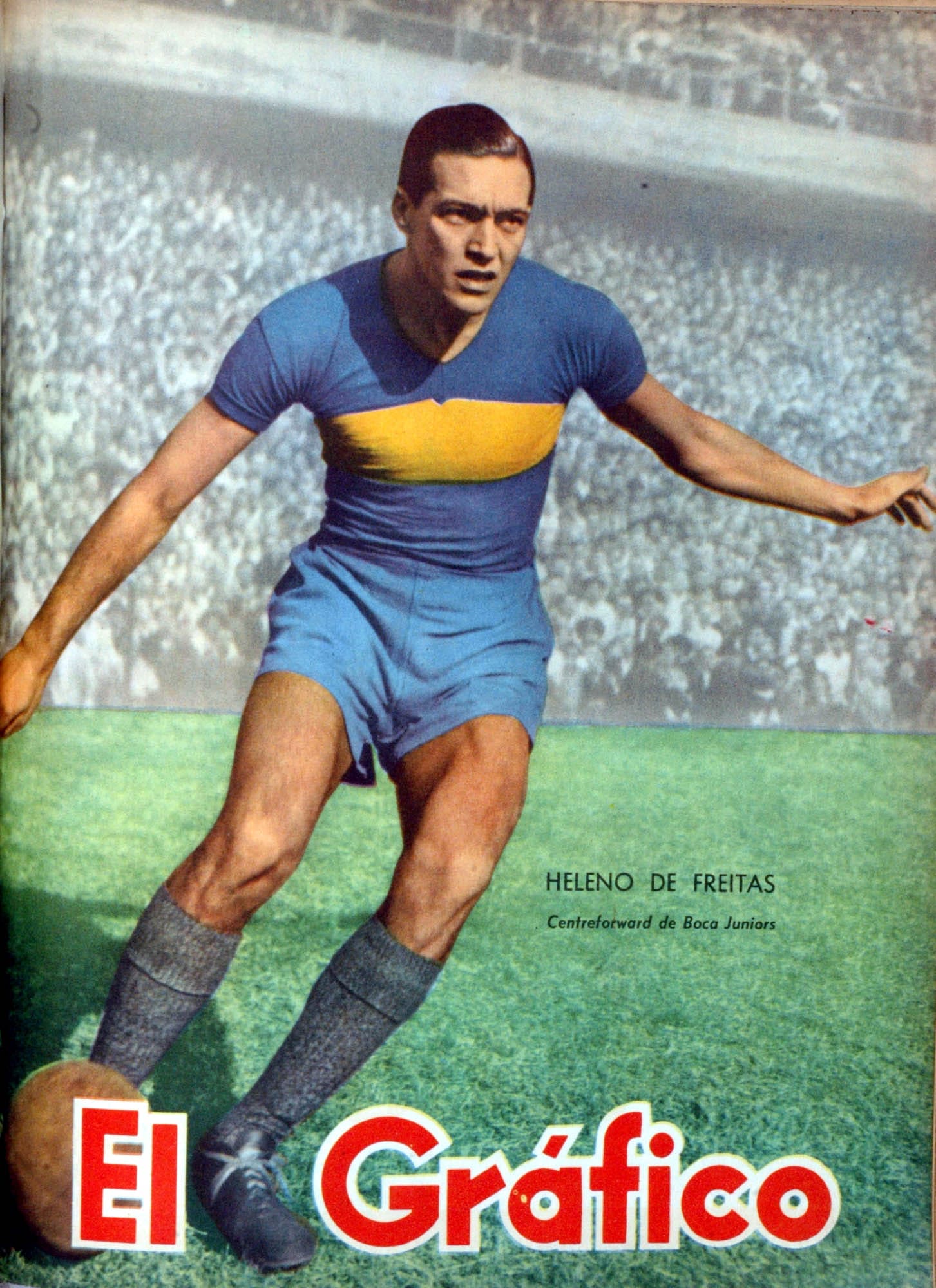
In 1948 Heleno made what was then the largest transfer in South American football, leaving Botafogo for Boca Juniors. He appeared on the cover of El Gráfico, the glossiest fame the continent could offer. It should have been a coronation. Instead Argentina seems to have been where the unravelling truly began. The torment that had always lived in him grew louder. The stay was short and unhappy, and he was soon back in Brazil.
There was one last flowering. He joined Vasco da Gama and in 1949 won the Campeonato Carioca, the only major title of his entire career, a desperate irony for a man who had scored more than two hundred goals without ever winning the league at the club he made his name with. Even this triumph carries a story that belongs in a noir. During a difficult spell at Vasco, by several accounts, Heleno walked into the stadium and pointed an unloaded gun at his manager Flávio Costa during an argument. It was empty. It was also, more or less, the end of him as a serious footballer.
Underneath all of it the disease was working. At some point Heleno had contracted syphilis, and when a doctor diagnosed it he refused the treatment on offer, terrified that the cure would dull his edge, soften the very thing that made him Heleno. So he treated himself instead, with handkerchiefs soaked in ether, breathing in the sweet anaesthetic for a brief and ruinous lift, a bottle never far from reach. He was poisoning his brain to protect his game, and he lost both. The sores climbed his back. The temper curdled into something darker and harder to explain, the rages of a man whose nervous system was being eaten from the inside while everyone around him assumed he was simply being difficult again.
There is something almost unbearable in the shape of it. Treatment for the disease was within reach in those years, a course of medicine that could have arrested the thing long before it reached his brain, and Heleno refused it. He was not ignorant of the danger. He simply decided that the cure frightened him more than the illness, that he would rather keep the sharp, cruel, dazzling edge of himself intact than be made dull and safe and ordinary. It is the choice of a man who could not tell his genius apart from his ruin, who suspected, perhaps rightly, that they were one thing wearing two faces. He kept the edge. It killed him.
The fall, once it came, was steep. His wife Ilma left him, and went on, by the accounts that survive, to marry his closest friend. Alone and short of money, Heleno took the only road left and joined the rebel Colombian league, the so called El Dorado, a pirate competition flush with cash and free of the international rules, signing for Júnior of Barranquilla in 1950. It was exile dressed as opportunity. He still, somehow, clung to the idea that he might force his way into Brazil's squad for the home World Cup. He never came close. The tournament was played and lost without him, the Maracanazo arriving on 16 July 1950 to break a nation's heart in the great new stadium, while the man who might have been its hero was a continent away and falling apart.
He came home in 1951. Santos signed him and got a single training session out of him before reality intervened. América of Rio gave him one final contract, and in it he reached the only piece of the dream that was still within his ruined grasp. He played at the Maracanã. It lasted about half a game. He was sent off in the first half, fought in the dressing room afterwards and had his contract torn up on the spot. That was the end. He was thirty one years old, and the most gifted forward of his generation had played his last match for a club that could not wait to be rid of him, in the stadium he had spent his whole life deserving and was allowed to keep for forty five minutes.
What came after football was not a coda. It was a sentence. For roughly six years his brother cared for him as the neurosyphilis hollowed him out, the bacteria clogging his mind, wrecking his body, ageing him decades in months. When his brother could no longer cope, Heleno was admitted to the sanatorium at Barbacena, an institution whose name would later become a byword for the horrors of Brazilian asylum care. There the cursed prince spent his final years, his fortune gone, his looks gone, his genius gone, a man of thirty something who looked ancient, sometimes lucid enough to speak, often not.
And there, in 1958, came the bleakest grace note of all. Brazil won the World Cup in Sweden, the tournament he had been born to win and had never been allowed to enter, and Heleno was alive to know it. A seventeen year old took his country's place in history. The man who might have been first was a patient in a hospital on a hill, watching the future arrive without him. On 8 November 1959 the complications of his illness finally took him. He was thirty nine. They buried him back in São João Nepomuceno, the small town where the rich boy had started out with the whole world apparently owed to him.
For decades Heleno was a rumour, a name passed between the kind of supporters who collect the game's lost saints. He had no World Cup to anchor him in the highlight reels, no crowded trophy cabinet to point at, no gentle late career to soften the ending. He had only the headers and the stories and the wreckage, which is precisely the sort of legacy that slips through the cracks of a sport that likes its heroes tidy and its endings happy. Then in 2011 the Brazilian director José Henrique Fonseca made a film about him, simply called Heleno, with Rodrigo Santoro in the title role, shot in a lush film noir black and white that suited the subject better than colour ever could. Its Brazilian release carried the subtitle O Príncipe Maldito, the cursed prince, and Santoro, a famously handsome man, somehow made you believe both the matinee idol of the 1940s and the wreck of a body the syphilis left behind. The film took liberties, as films do, and Heleno's family disputed parts of it. But it put his face back in front of a country that had largely let it fade, which is more than the record books ever managed.
The what if hangs over everything, because it cannot help it. There are Brazilians who will tell you, with total conviction, that had Heleno de Freitas been fit and in the side in 1950, the Maracanazo would never have happened, that his arrogance and his certainty and his eye for a finish were exactly what that nervous, fragile team lacked in its hour of need. It is unprovable and probably unfair to the men who actually played. It is also irresistible, which is precisely the kind of myth a man like Heleno generates, the sense that his absence shaped history as much as his presence ever could.
He never played a World Cup. That is the line that ends every account of him, and it is almost the wrong one, because it makes the tournament sound like the thing he lacked when really he was the thing the tournament lacked. The game builds its statues to the men who finished their stories cleanly, who won the right trophy at the right age and retired into legend. Heleno finished nothing cleanly. He was a law graduate who chose the ball, a rich boy who died poor, a man who scored more than two hundred goals and won one title, the most beautiful forward of his time and the most ruined, the prince who was promised everything and crowned himself, with great care and over many years, with nothing at all.
Dios del Fútbol is part of the Headers and Volleys Fanzine Network.