Tostão: The Eye, the World Cup and the Doctor He Became
Tostão a World Cup winner and Pelé's quiet equal walked away, became a doctor and never looked back.
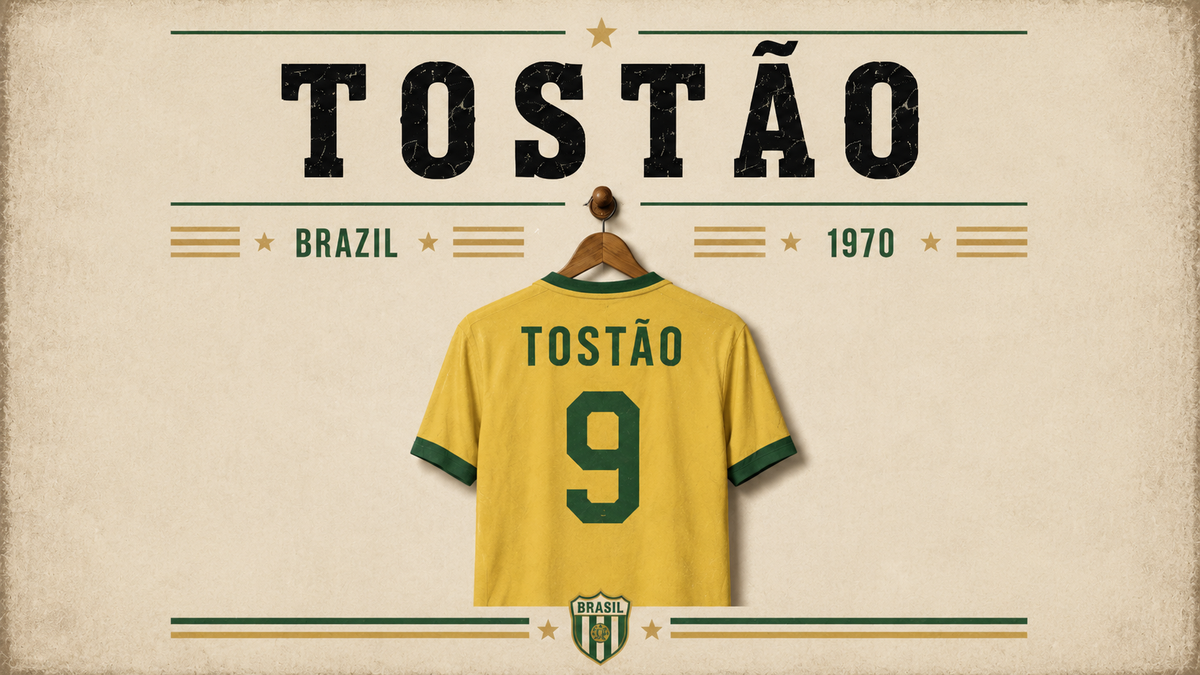
A detached retina ended his career at twenty six. So the World Cup winner and Pelé's quiet equal walked away, became a doctor and never looked back.
In the spring of 1970, a few weeks before the World Cup, a young Brazilian climbed into the carriage of a rollercoaster at Disneyland and let it throw him at the sky. He had a reason. Months earlier a cleared ball had struck him flush in the left eye and detached the retina, and the American surgeons who rebuilt it had warned him that another sharp jolt could tip him into darkness for good. So he chose the most violent ride in California and dared the eye to fail. It held. His name was Eduardo Gonçalves de Andrade, and the world has only ever wanted to call him Tostão.
The wager tells you almost everything. Here was a man who would gamble his sight on a fairground ride rather than miss a tournament, and who, three years later, would refuse the same gamble for the rest of his life and walk away from football forever at twenty six. Between those two decisions sits one of the strangest and most quietly beautiful careers the game has produced. A genius cut down before his prime, who did not break, did not drink himself into the ground, did not haunt the touchlines of his old grounds like a ghost. He simply became someone else. He became a doctor.
He was born on 25 January 1947 in Belo Horizonte, the mining city in the hills of Minas Gerais, and the name came early. A tostão was a small coin, an old Brazilian penny, almost worthless, and it stuck to a boy who looked too slight to matter on a football pitch. Legend has it he once put forty seven goals past some helpless school side and earned the nickname that way, though the simpler story is the truer one. He was little. He was the small change. Nobody looking at the child would have bet a tostão on what he became.
What he became, first, was the cleverest footballer in Brazil. Not the fastest, never the strongest and, by his own cheerful admission, not the most gifted with the ball at his feet. What Tostão had was a mind that ran at a speed the rest of the game could not follow. He played with his back to goal and his head already turned, seeing the pass two moves before it existed, drawing defenders towards him like a magnet and then releasing the ball into the space they had vacated. He was a minimalist. He wasted nothing. Everything sped up around him and he stayed still at the centre of it, calm as a man doing sums.
He left the youth ranks of América Mineiro as a teenager and crossed the city to Cruzeiro, and it was there that he built the legend that still belongs to him. Minas Gerais in the middle sixties was football country waking up to its own strength. A vast new stadium, the Mineirão, had risen in Belo Horizonte, and into it walked a Cruzeiro side that intended to stop being a provincial name and start being a national power. Tostão was the reason it worked. He is the all time leading scorer in the club's history, something close to two hundred and forty nine goals depending on whose ledger you trust, and the casual arithmetic of Brazilian football in those years means nobody can swear to the last figure. What is not in doubt is that he was the best thing in blue.
In 1966 Cruzeiro met Pelé's Santos in the final of the Taça Brasil, the national title of the age, and the meeting carried a weight beyond the trophy. Santos were the champions of the world, the team of the king, the standard against which every other Brazilian was measured. Cruzeiro beat them, and they did not scrape it. They took them apart over two legs, and the boy from the hills was at the heart of it. The Brazilian press, never shy of a coronation, started calling Tostão o Novo Rei. The New King.
He hated it. Years later he remembered the headlines with a wince and a laugh. The press kept asking him to measure himself against Pelé, and he kept refusing, because he understood the comparison better than they did. The best I can do, he said, is think like him. I can have his logic, his reasoning, but I will never have the technique or the strength to carry it out. It was about thinking. It was always about thinking. Quick thinking, he said, is a good quality whatever you do. Be concise. Be a minimalist. Decide without delay.
That was the secret of the partnership that would define him. When Tostão and Pelé played together they seemed to share a single nervous system. The great chronicler Armando Nogueira wrote of telepathy between them, of two men who knew each other's intentions before they were formed. Tostão, ever the rationalist, preferred a cooler word. He called it analogue communication. He would peel away to the left, drop deep, vacate the centre, and Pelé would arrive in the gap he had made as if the two of them had agreed it in a language nobody else spoke. He was the brightest player ever to share a pitch with the greatest, and he spent his life insisting that the brightness was only ever a kind of borrowed light.
He was, though nobody used the word then, positionless. He wore the shirt of a centre forward and played almost nowhere near the centre, forever drifting out to the left or dropping into the space between the lines where defenders did not know whether to follow him or hold their shape. If they followed, the middle opened for somebody else. If they held, he had the ball and the time to do something cruel with it. Coaches half a century later would build whole systems around the idea of a forward who comes to meet the play rather than waiting on the last shoulder. Tostão simply did it, on instinct, with one good eye, because it was the most economical way to hurt a team and economy was the whole of his religion.
His first World Cup gave him almost nothing, and what it did give him was a wound. England 1966 was a tournament Brazil would rather forget, the champions of 1958 and 1962 hacked out of the competition in the group stage, Pelé kicked from pillar to post by defenders the laws of the game did not yet protect, the golden side suddenly old and slow and bitter. The young Tostão scored in the 3-1 defeat by Hungary, a flash of the future in the middle of a wreck, but it counted for nothing. Brazil went home early and humiliated, and the boy who would carry the next cup went with them, knowing the next one was his to win or lose. He could not have known how nearly he would lose it before a ball was kicked.
The blow came in 1969. He was playing against Corinthians when a defender named Ditão cleared a wet and heavy ball without looking, and Tostão's face was in the way. The ball took him in the left eye. A detached retina is a quiet catastrophe. There is no blood, no scream, only a curtain drawing slowly across the world, and for a footballer one year out from a World Cup it was close to a death sentence for the dream. He travelled to the United States for surgery, lay still for months in a darkened room while the eye healed, forbidden to move his head, and waited to learn whether he would ever play again, or see again, which suddenly mattered a great deal more than football ever had.
The wait was not only medical. While Tostão lay still, the Brazil team itself was at war with itself. João Saldanha, the fierce former journalist who had built the qualifying side and made Tostão an undisputed starter, was a brilliant and combustible man who could not stop picking fights, and in March 1970, with the tournament only weeks away, he was removed and replaced by Mário Zagallo. The whole project trembled. A recovering forward with one good eye could have been quietly left behind in the reshuffle, and nobody would have blamed the new coach for caution. Tostão refused to be left behind.
This is where the rollercoaster comes in, and it is too good and too well attested to leave out. Before the final tests, with the surgeons due to pass judgement, Tostão decided to run his own examination. He went to Disneyland and rode the wildest machine they had, reasoning that if his rebuilt retina could survive that it could survive anything Mexico would throw at it. The eye held. The doctors gave him the all clear with a month to spare. He had bet his sight on a theme park ride and won, and the prize was a place in the most beautiful football team that has ever existed.
The spine of that team was extraordinary. Pelé, Gérson, Jairzinho, Rivelino, Carlos Alberto and Tostão, six attacking minds asked to play together and somehow doing it, a side that defended by attacking and attacked by remembering where everyone else was going to be. Tostão was its quiet compass. He was not there to score, though he scored. He was there to make the others inevitable, to draw a centre half out of position with a drop of the shoulder and leave a door open for Pelé, to hold the ball with his back to goal for the half second it took Jairzinho to start running. Watch the 1970 side and the eye keeps sliding past him towards the men finishing the moves. Look again and he is the one who started them.
The record books cannot quite agree on what he scored, in Mexico or anywhere else, and the honest thing is to say so. The cleanest count gives him thirty two goals in fifty four games for Brazil, others push the caps to fifty five and the goals towards thirty six, and the goalkeepers of memory have been generous with some of those numbers over the decades. What is certain is that he started all six matches of the 1970 World Cup, that he scored twice on the road to the final, and that he was, alongside Pelé, the creative heart of a side that won every game it played. On 21 June 1970, Brazil beat Italy 4-1 in the Estadio Azteca to win the cup for the third time and keep the Jules Rimet trophy forever. Tostão was twenty three years old. He was a world champion. He had, by any reasonable measure, his whole career in front of him.
He had three more years.
The eye came back for him. The retina that had been rebuilt in 1969 was never truly safe, and the warnings grew louder until they could not be ignored. To keep playing was to keep gambling, and this time the stake was not a tournament but his sight itself, and this time he refused the bet. In 1973 he retired from football at twenty six, an age when a forward is supposed to be walking into the full command of his powers. There was no farewell tour, no long slow fade, no testimonial under the floodlights with the crowd in tears. He had won the World Cup, scored a club record that still stands, been crowned and uncrowned by the newspapers, and now he was finished, and he chose his eyes over the only life he had ever known. It is a harder thing to do than to keep playing and let the game take what it wants. He did the harder thing, and he did it quietly, and then he was gone.
What he did next is the part the highlight reels never reach, and it is the part that makes him worth a chapter rather than a footnote. He did not coach. He did not commentate his way through middle age clinging to the warmth of the dressing room. He enrolled in medical school at the Universidade Federal de Minas Gerais and became a doctor. A real one. He qualified. He practised for the better part of twenty years. He taught. And for two decades he stepped almost entirely out of the game that had made him famous, into a separate life he guarded with something close to ferocity.
He was not a celebrity doctor, not a name lending itself to a clinic. He did the work. He sat with patients who had no idea that the quiet man taking their history had once been the New King of Brazilian football, and he seems to have preferred it that way. The retreat was not bitterness. He never spoke of the game with the sourness of a man robbed, never picked at the wound of what the eye had taken. He had decided, with the same speed he once decided where to put a pass, that there was a whole life waiting on the other side of football, and he went and lived it.
It was not easy, and he never pretended it was. He talked, late in life, about the difficulty of being two people. There was Eduardo, the doctor and the teacher and the private man, and there was Tostão, the World Cup winner the whole country wanted a piece of, and he spent his energy trying to keep them in separate rooms. It almost never worked. His fellow medical students wanted to talk about Mexico. His professors wanted to talk about Pelé. The myth followed him into the lecture hall and sat down beside him at the dissecting table, and there was no operation that could remove it. He understood, better than most who carry a famous name, the quiet violence of being reduced to your own legend. Is Jair separate from Jairzinho, he wondered. Does Hércules exist without Brito. Some men, he said, became captives of their own success, unable to build a self out of anything but the past.
Pelé, he believed, never suffered this. Edson and Pelé fused long ago into one mythical creature and there was no seam left to ache. But Tostão felt the seam. He felt the gap between the boy who was named after a worthless coin and the figure other people insisted on worshipping, and the genius of his second life was that he learned to live across it rather than choosing a side. The footballer had moved men around a pitch by understanding where they wanted to go. The doctor moved through his own fame the same way, calm, economical, refusing to waste himself on the parts of it that did not matter.
The exile ended in 1994, when football came knocking again and this time he let it in on his own terms. He returned not as a coach or a pundit selling certainty, but as a writer and an analyst, and he turned out to be magnificent at it. His columns in the Folha de São Paulo became among the most read and most respected words written about the game in Brazil, cool and clear and allergic to cliché, the work of a man who had spent half his life learning to see in two directions at once. The minimalist who wasted nothing on the pitch wasted nothing on the page either. He wrote about football the way he once played it, thinking two moves ahead, drawing the reader towards the obvious point and then releasing the thought into the space where the truth actually sat. It is a strange and lovely irony that the man who tried hardest to leave the game became one of the few people in Brazil able to explain it.
There is a temptation, with a story like this, to mourn. To stand at the edge of 1973 and grieve the cups he never won, the decade of brilliance the eye stole, the place in the pantheon a longer career might have bought him. Even now the lists of the greatest forwards tend to leave him in the margins, the lesser vaunted of that golden Brazilian line, the one people forget to name between Pelé and Jairzinho. And it is true that an eye took something from him that he could never get back, and true that the game is a little poorer for the years it never saw.
Those who actually watched him do not forget. The men who played with him and against him put him among the very best of his time, some of them ahead of everyone but Pelé, a few even level with him in the years before the eye. He has the rare distinction of being underrated only by people who never saw him, which is to say by almost everyone now alive. That is the cost of going early and going quiet. The footage is thin, the goals are scattered across grainy reels and the legend was never fed by a long decline that kept his name in the papers. He left at the top and let the silence do the rest.
But to leave it there is to miss the whole point of the man. Tostão is not a tragedy. He is the rarest thing in football, a cautionary tale that refuses to end badly. The career died young. Eduardo did not. He kept his sight, kept his mind, kept his quiet and built a second life as full as the first and longer by far, and then he came back and wrote about the game with more wisdom than almost anyone who never had to leave it. Most footballers are remembered for what they did before they were thirty. Tostão has spent fifty years quietly proving that a man can be more than the best thing he ever was.
The boy was named after a coin that nobody thought was worth anything. He grew up to be priceless twice, once with his feet and once with his head, and the second time he cashed it in a currency the game never saw coming. An eye nearly cost him everything. In the end it only cost him football, and he turned out to have plenty else worth keeping.
Dios del Fútbol is part of the Headers and Volleys Fanzine Network.